google.com, pub-5161388013621688, DIRECT, f08c47fec0942fa0 Traveloscopy Travelblog Traveloscopy Travelblog

April 21, 2008

The Costa Cruises Story

Text: Costa Cruises Postcard Scans: www.simplonpc.co.uk

The story behind Costa Crociere is a story of entrepreneurial success.

It was established in 1854 under the name of the founder “Giacomo Costa fu Andrea” and was so successful in the trading of fabrics and olive oil between the markets of Genoa and Sardinia that it soon set up a fleet of ships transporting goods all over the world; and by the end of the last century its goods reached far-away shores such as Australia, where the constant flow of Italian emigrants generated a market for national foodstuffs.

Costa was specialized in the purchase of raw olive oil in the Mediterranean countries for export overseas.

In the first decade of the twentieth century Costa was in a position to enter the naval field: in 1924 the small steamship Ravenna was used to supply raw materials to markets in the western Mediterranean and in 1928 the Langano was added to the fleet.

The thirties saw the start of the tradition of naming the ships after members of the family: Federico (’31), Eugenio and Enrico (’34), Antonietta, Beatrice and Giacomo (’35).

At the start of the Second World War the fleet boasted eight ships for a total of 27,534 tons.

Only the Langano survived the war, but Costa took up its shipbuilding activities again, building and buying other ships for coastal trading.

The destruction of the Italian passenger fleet, the growing demand for passenger traffic, the economic crisis and the flood of emigrants across the ocean drew the attention of the far-sighted Costa family, and in 1947 they inaugurated a new passenger service, first class - equipped with air conditioning - and second class. It was the steam ship Maria C. that began to meet the first demand for passenger transport, quickly followed by the Anna C. (pic right), the first Italian transatlantic to cross the western Atlantic after the war. In 1947 Giacomo Costa fu Andrea became “Linea C.”.

The commercial services towards North America were inaugurated in 1948 with the art nouveau style ship Maria C., soon flanked by the Luisa C. In 1953 the Franca C. opened new routes towards Venezuela and the Antilles.

The launching of luxurious, new ships, equipped with air conditioning in first and second class and with comfortable and elegant rooms, impeccable service offering hospitality, comfort and the best of traditional Mediterranean cuisine denoted the unmistakable Italian style.

A style which reached its zenith in the fittings, the furnishings and the architectural styles.

Even Giò Ponti, director of the magazine Domus, turned his attention to naval matters and mentioned the architectural and decorative aspects of the Costa fleet. A tradition which continues today.

The ships were divided into three classes (first, second and tourist), the entertainment and the attractions for the passengers, whether adults or children, are still a characteristic of the Costa fleet which has been continuously growing since the fifties.
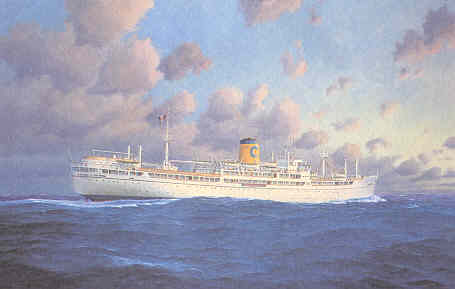
Bianca C., Enrico C., Andrea C.(pic left), Flavia, Fulvia and Carla C. were refurbished in the fifties to offer something more than a mere means of transport. Until the inauguration of the first ship commissioned by Costa from the Genoa shipyard Ansaldo.The Federico Costa, still divided into three classes, was equipped with restaurants and unusually shaped swimming pools.

In 1959 Costa realized the first ship in the world completely dedicated to pleasure cruises of 7 and 14 days in the United States and the Caribbean: the Franca C., flanked in the winter months by the Anna Costa, which proposed 3 or 4-day mini cruises starting from Port Everglades to Bahamas. The early 1960’s were triumphal and the by then customary routes in South America or the Caribbean were joined by cruises in the Mediterranean, the Black Sea, in Brazil, Uruguay and Argentina, right down to the Straits of Magellan and the Antarctic. The success of the Linea C was such that in 1964 the Company ordered the construction of the Eugenio C. Immediately christened “the ship of the future” thanks to its fittings and its elegance.
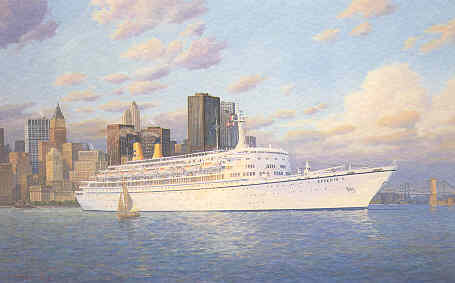
A ship no longer formally divided into three classes, but conceived as a single deck, onto which all the lounges face. A clear indication that the Eugenio C. (pic left) would be totally dedicated to cruising, the choice for the future of Costa Armatori. In 1968 the first ship exclusively used by passengers, the Franca C. inaugurated the formula of “fly and sail”, destined to revolutionize the conception of holidays and offering holiday-makers with little time to spare the opportunity to take short cruises in distant parts of the world. Once again the evolution of tourism has proved Costa right, during the seventies the fleet was increased with ships leased or bought outright.

Particularly noteworthy were the splendid twins Daphne and Danae, who sailed the Mediterranean in the summer and the Caribbean in winter, with trips to Alaska, Scandinavia, South America, Africa and the Far East.

During the eighties the idea of the ship as a floating hotel became increasing accepted.

The ships became holiday resorts, the division between the classes disappeared completely, the cabins tended to become more uniform and the places of entertainment multiplied: bars, theatres, casino, discotheque. Everything was available to everyone. Building on the foundations the cruising industry in general and Costa Armatori in particular prepared for the great leap in quality represented by the founding of Costa Crociere in 1986.
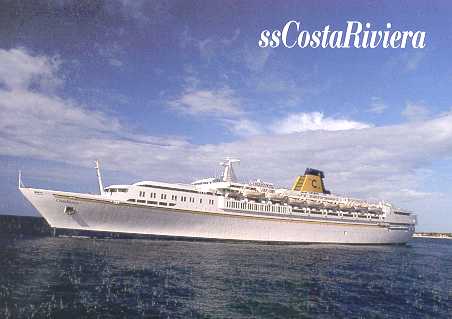
But once again, the ships are the stars of the enormous development of the company, from the Costa Riviera, completely refurbished in 1985 and in 1998, to the ships built in the nineties; the Costa Marina, the Costa Allegra, the Costa Classica, the Costa Romantica and in 1996, the splendid Costa Victoria.

Not to mention the Mermoz and the Costa Playa (later sold), purchased in 1993 when Paquet Cruises of the French group Chargeurs & Accor was dismantled.

In 1997 the company was purchased by the American firm Carnival (50%) and the English firm Airtours (50%), increasing the investment capacity of the Genoese company while maintaining its identity as an Italian company.

The growth of Costa Crociere has never stopped. In November 1999 the technical launching of the Costa Atlantica, the new flagship christened in the wonderful setting of Riva ai Sette Martiri in Venice in July of 2000, opens a new page in the company history.
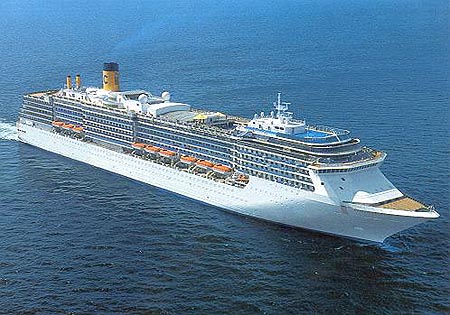
The Italian flag returns, after about ten years, to wave on the yards of Costa’s ships and the company introduces a new concept never seen before. With its dimensions, which makes her the biggest passenger ship in the history of Italian maritime, the Costa Atlantica (pic left) opens the path to the new company development guidelines: comfort cabins like grand hotel rooms, most of with a balcony, a series of unforgettable ambiences and atmospheres which will attract new passengers to the cruise experience.

In August 2000, Costa Crociere announced the order of the Atlantica’s twin ship, the Costa Mediterranea.

At the end of September 2000, The Carnival Corporation, having purchased all shares from Airtours, became the sole shareholder of Costa Crociere, Genoa.

This change gives a further incentive to the Development Program of Costa and confirmed a new deal with Fincantieri in Genoa Sestri Ponente to build two new 102,600 ton cruise ships and with a total passenger capacity of 3,470, the Costa Fortuna and the Costa Magica, for delivery at the end of 2003 and 2004. The expansion of the company has been possible by the addition in June 2001 of another ship, the Costa Tropicale, originally belonging to Carnival Cruise Lines, which was completely refurbished in the style of other Costa ships. Moreover, in March 2001, Costa announced the purchase of the ship Westerdam from the American sister company Holland America Line, which entered in service at the end of April 2002 under the name of Costa Europa.
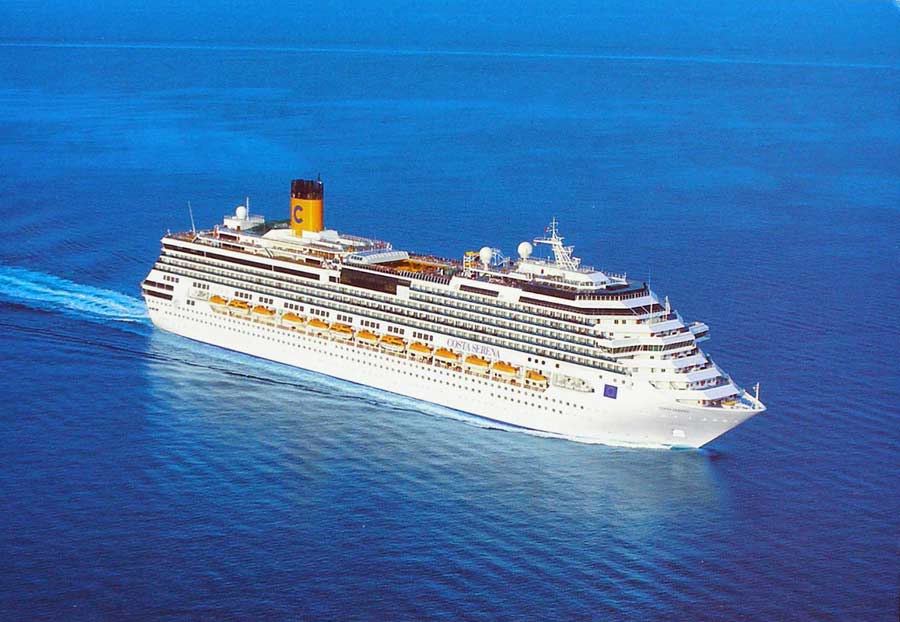
The Costa Mediterranea, twin sister of the Costa Atlantica, was delivered to the company on May 22, 2003. November 14, 2003 marked the arrival of the Costa Fortuna. The Palacrociere, Savona's new cruise terminal, jointly financed and managed by the company, was opened on November 24, 2003. In January 2004 Costa Crociere announced the signing of a letter of intention with Fincantieri for the construction in Sestri Ponente of another new ship with a tonnage of 114,500 tons and with a total passenger capacity of 3,780, the Costa Concordia, which will go into service in the summer of 2006. On October 29th, 2004 the Costa Magica, twin sister of the Costa Fortuna, was delivered. In the same year Costa Crociere S.p.A. acquired the brand AIDA Cruises, the cruise leader in Germany. In January 2005 Costa Crociere announces the order to Fincantieri for a twin sister ship of the Costa Concordia, the Costa Serena (pic above left), which will be ready in spring 2007, and transfer of the Costa Tropicale to the P&O Australia brand in October 2005. The growth programme of the fleet continued in December 2005 with the announcement of a third sister ship of the Costa Concordia and of the Costa Serena, named the Costa Pacifica, to be delivered by Spring 2009.

In 2006 Costa announces its expansion in Asia Pacific and in Dubai, confirming its international character. In June 2006 Costa placed an order with Fincantieri for two new 92,700-ton ships to be built at the Fincantieri Yard in Marghera, the Costa Luminosa (pic right) and its sister ship, which will come into service in Spring 2009 and 2010. In July 2006, the Costa Concordia came into service and in February 2007, Costa announced new exclusive itineraries from Mauritius to the Seychelles, Kenya and Madagascar. In April 2007, the new “Palacruceros” terminal, owned and financed by the company, was inaugurated and in May 2007, the Costa Serena was delivered. On July 17, Costa Crociere reached a historical record in Europe: 1,000,000 Guests booked in only one year. The announced joint venture between Costa Crociere S.p.A. and Orizonia Corporaciòn was approved for the creation of the brand “Iberocruceros”, belonging to the Costa group and operating in the Spanish market. In October the order to Fincantieri for 2 further ships of the “Concordia” class was announced.

Costa thus enters the third millennium with an expansion program that will enable it to maintain its European leadership in a fast growing market. The fleet that will fly the Italian merchant marine flag in years to come will be even more modern, offering Italian-style hospitality and an unparalleled showcase of Italy's artistic trends.

Costa Crociere has been part of Carnival Corporation & plc, the world leader in the cruise sector, since April 2003. AIDA Cruises, the leading brand in the German speaking market, with four ships in service and five on order, and Iberocruceros, operating in the Spanish market, with two ships in service and one on order, both belong to the Costa Crociere S.p.A. Group, completing a total of 18 ships in service and 11 on order. All ships fly the Italian flag.

LET FRANCESCA SHOW YOU LA DOLCE VITA

LET FRANCESCA SHOW YOU LA DOLCE VITA

david ellis

SO you want to hire a train so you and your mates can see Italy in style.

And a palace too, for a slap-up birthday bash along the way – complete
of course with your own orchestra and a fireworks show in a cosy
little Italian bay below as you celebrate the big day.

And to finish, when you get back to Rome, you'll expect a few-score
chauffeur-driven Mercedes on hand at the station to whisk the lot of
you to the airport in the style to which you've become accustomed.

Dreaming?

Not if you talk to Francesca Alberghini, a blonde dynamo with
Rome-based company DDP Incentive Management who creates la Dolce Vita
for the well-heeled (and the sometimes odd-ball) as easily as a
magician plucks rabbit from a hat.

Plus she's got a few hundred other tricks up her sleeve: how about a
horse and carriage ride around Rome or Florence, Venice or Naples? Or
being serenaded by a children's choir at a lakeside picnic – or taking
a side trip to a dozen of Italy's most famous cities and sights?

Or simply settling down to a white-glove Pasta, Pizza and Wine party.

Ms Alberghini, as you've probably begun to appreciate, is not your
ordinary party organiser. She's been in the special events business
thirty years, after joining her dad in their hometown Naples where
he'd set up a business to look after the whims and fancies of those
wanting something really different in the way of corporate or private
family functions and celebrations.

Sadly Egypt's closure of the Suez Canal from 1967 to 1975 proved not
only a mortal blow to the Alberghini business, but to many others in
the travel industry in Naples as well.

"After Dad's business folded we moved to Rome to start all over again,
but Dad died just a year later," Francesca says. "I was only 20 at the
time and Mum and I tried to keep things going, but we lasted just
another year."

Francesca joined another company and specialised in looking after
corporate and private clients wanting something unique and unusual
during celebratory cruises and other special holiday or company
events.

And five years ago she switched to DDP Incentive Management where her
skills at weaving together the threads of the seemingly impossible,
and at times the outlandish, blossomed.

To Francesca there's no such word as No.

When an Aussie businessman chartered the mega motor-cruiser SeaDream
II for a week out of Rome with nearly a hundred mates a couple of
years back for his 50th birthday, his wife decided fireworks would be
nice to mark the Big Night.

So SeaDream Yacht Club asked Francesca to organise a barge-load of the
things, and as the birthday banquet unfolded on the deck of SeaDream
II in Portofino Harbour, guests gasped as the pyrotechnic spectacular
lit not only the whole of Portofino, but the surrounding "millionaires
row" Tigullio Gulf as well with ten minutes of smoke, flare, flash and
flame.

On another occasion a romantic Frenchman wanted 15,000 fresh roses
placed in every public area and in every stateroom on that same
SeaDream II during his week-long Mediterranean charter.

And another charterer wanted 10,000 rose petals scattered around the
pool deck as his friends came aboard to join him for his special week.
And yet another asked that his guests be led from cocktails to dinner
each evening by two turbaned Indians in traditional dress who'd been
brought aboard purely for these evening rituals.

Francesca remains totally unfazed by the many requests she receives,
saying that Italy stimulates in people emotions they often conceal at
home. "Our culture, history, gastronomic delights, arts and fashion –
all of them so much 'The Italian Way of Life' – inspire visitors to
express their true feelings,

"We're simply catering to their requests, no matter how unusual or out
of the ordinary they may seem," she says.

And it's not just the out of the ordinary: Francesca and DDP Incentive
Management also organise everything from seemingly mundane airport to
hotel limousine transfers, or booking a restaurant for a special
dinner.

"We strive to turn every traveller's dream into a reality," Francesca says.

If there's anything from that simple airport transfer, to your own
train, a stay in a palace, 15,000 roses or other touches of la Dolce
Vita, contact this bubbly dynamo on Francesca@ddpincentive.it

………………………………

PHOTO CAPTIONS:

SHE may have a fleet of close-on a hundred Mercedes at her disposal,
but Francesca Alberghini still likes to scoot around Rome on two
wheels – here she shows the writer some of the Eternal City's
highlights.

UP in smoke: Francesca organised this spectacular fireworks display
for an Aussie businessman who chartered SeaDream II out of Rome to
celebrate his 50th birthday with a hundred family and mates.

PART of the luxury fleet – DDP Incentive Management can get you one
Mercedes-Benz for an airport transfers, or a hundred for the company
or family Mediterranean fling.

(Photos: DDP Incentive Management; David Ellis)

April 14, 2008

TARGETTING THE ‘REAL’ ROBIN HOOD

TARGETTING THE 'REAL' ROBIN HOOD

malcolm andrews

THERE would hardly be a person in the English-speaking world who has
not heard of Robin Hood.

With his band of Merry Men he thrived on robbing the rich to give to the poor.

Little John and Friar Tuck – names almost as familiar as Robin Hood
himself – and the love of his life, the beautiful Maid Marion… the
wicked Sheriff of Nottingham who would scour Sherwood Forest in search
of the brigand, all once lived in Nottingham.

Or did they and Robin Hood?

Every year thousands of tourists pour into the city of Nottingham and
nearby Sherwood Forest to feel the Robin Hood experience.

But the folk of the village of Clifton in West Yorkshire will tell you
these tourists have got it all wrong.

Over a pint of best bitter in the Black Horse Inn they'll quote the
history books to prove that if you're looking for the domain of Robin
Hood you should be pottering around Clifton, not Sherwood Forest
that's a few hundred kilometres away.

For starters they'll tell you, history says there never was a Sheriff
of Nottingham… in Robin Hood's day there was a Sheriff of Yorkshire.

And the drinkers at the Black Horse will explain that our hero's real
name was not Robin Hood, but Robert Hood of Wakefield, an old
industrial centre near Clifton.

As well, just down the road from the Black Horse is the site of
Kirklees Priory, in whose gatehouse Robert Hood spent his dying hours
back around 1346. Stories claim he was 'bled' by the prioress and left
for dead.

When Little John found him in his death throes, Robert – or Robin –
Hood made one last request: he had Little John prop him up so he could
fire an arrow through the window, and request that he be buried where
it landed.

But from the gatehouse in which he is supposed to have died, its 600m
to his grave – almost twice the range of a skilled longbow archer. And
Robin Hood was around a venerable 70 years at the time he died.

And much as they wish they could, tourists can't visit where Robin's
arrow allegedly landed – it's on private property. And even if they
could get there, they'd find a fake gravestone anyway.

The original monument disappeared some time around 1670. A replica was
made. But locals chipped pieces off it believing that by placing it
against their cheek, they would be cured of toothache. Another
replacement was made in the 19th century – replete with Olde English
wording in an attempt at 'authenticity'.

It's not a bad story. And the local real estate folk are not about to
reject it.

The Black Horse Inn in Clifton also has links with more recent
history. On the walls of its bar are autographed photographs of some
of the pop music legends of the 1950s and 1960s.

Johnny Ray. George Hamilton IV. Eartha Kitt. Del Shannon. Gerry and
the Pacemakers.

They seem quite incongruous in this tiny Yorkshire village.

But Mine Host Andrew Russell has a ready explanation. In nearby
Batley, a dour workers' village that in the 1960s had seen better
days, an entrepreneur named Jimmy Corrigan established, in a converted
sewage works, the Batley Variety Club.

Waving a fat cheque book he lured the biggest names in the world to
this musical oasis in the grim north of England.

Louis Armstrong's two-week gig in June 1968 put the club on the map.
And the likes of Roy Orbison, Johnny Mathis, the Everly Brothers and
Neil Sedaka cemented its fame.

But the stars had no desire to stay in Batley – and word soon got
around that the Black Horse Inn at Clifton provided a better retreat.

"They kept coming back time and time again," Russell explained. "And
they have continued to do so even though the Batley Variety Club
ceased its big shows three decades ago. The aging stars now come for
holidays."

George Hamilton IV, who had huge country hits with Why Don't They
Understand and Abilene, is a regular. Now aged 70, he has been coming
back every couple of years.

He's now arguably the village's most famous septuagenarian since Robin
Hood himself.

……………………..

Picture captions

Robin Hood's statue is in Nottingham.... even though the people of
Clifton in West Yorkshire still claim him as their's.

The historic Black Horse Inn... a landmark of note from Robin Hood to
Roy Orbison, the Everly Brothers and George Hamilton IV, who still
visits for a pint today.

Photos: Malcolm Andrews

April 07, 2008

HOLY WATERING HOLE

HOLY WATERING HOLE

malcolm andrews

THAT noted 18th Century cleric John Wesley would be none too pleased
if he were to walk through the Yorkshire township of Brighouse today.

The founder of the Methodist (Uniting) Church was a teetotaller who
would preach on the evils of the demon drink from the pulpits of
chapels around England.

Brighouse, near the northern city of Bradford, was the site of one of
the most beautiful Wesleyan chapels in all of Britain.

Called The Park Chapel it was built in 1878 at a cost of 10,000
pounds, a King's ransom back then. The architect R.F. Rogerson was
deeply influenced by his love of French chateaux so the structure
stood out in an area dominated by massive, ugly-looking wool mills and
grim workers' cottages.

The Chapel closed in 1983 and the building became an indoor market
before that, in turn, closed down in 1999.

Today, much to the horror of Yorkshire Methodists, it is a pub – the
Richard Oastler, one of a chain around the country offering
reasonably-priced counter meals and drinks to hungry, thirsty
travellers. Or, for that matter, non-United Church locals.

Everything from traditional fish 'n chips and bangers 'n mash to
Chicken Tikka and Chili Con Carne is served here.

And for dessert Toffee and Banana Pudding, Treacle Sponge and
Chocolate Fudge Cake, of which the menu boasts "All of our hot
puddings are large enough to share."

The JD Wetherspoon group that owns the Richard Oastler targets classic
buildings to be renovated as pubs, although more than a few of the 689
establishments are housed in ugly modern buildings – the only places
available in some areas into which the company wished to move.

Wetherspoon's marketing people have bestowed some unusual names on
their properties.

In London there are the Beaten Docket (Cricklewood), Good Yarn
(Uxbridge), Tally Ho (North Finchley), Asparagus (Battersea), the
Wrong 'Un (Bexley Heath), the Whole Hog (Palmers Green) and the Cap in
Hand (Surbiton).

Wetherspoon chiefs obviously like the name Moon Under Water because
there are several dotted around London and its environs...Charing
Cross, Leicester Square, Balham, Barnet, Enfield, Colindale,
Twickenham and Watford.

The Knights Templar in London's Chancery Lane conjures up visions of
Tom Hanks doing battle with assorted villains in the Da Vinci Code
movie.

And the Last Post in Loughton is a bit of a worry.

But in the country the company is more likely to use the name of
interesting figures from British history.

At Bury in north-west England there's the Robert Peel, named after the
creator of the world's first police force who was born in Bury in
1788.

Trowbridge in Wiltshire boasts the Isaac Pitman, who gave the world
shorthand, the bane of young journalists before modern miniature
recorders were invented.

James Watt, the inventor of the steam engine, is commemorated in the
Scottish town of Greenock, where he was born in 1736.

And in Brighouse, the converted Methodist chapel with its magnificent
pipe organ dominating one end of a first-floor gallery recalls the
deeds of Richard Oastler, who lived nearby.

Oastler is remembered to this day for his vehement opposition to child
labor. When his followers dubbed him 'The Factory King', his opponents
sneeringly called him King Richard, a title he wore with pride.

Oastler's campaign was highlighted in 1830 when he described the
treatment of child workers as 'Yorkshire Slavery'.

The fight gathered momentum so rapidly that within three years the
British Parliament had banned children under nine from working in
textile mills and limited those under 13 years of age to nine hours a
day.

When he campaigned for an even better deal for children his opponents
managed to have him imprisoned in 1840 for debt. But each week from
his cell in London's Fleet Gaol he published a newsletter continuing
his campaign. And with money raised by friends he was eventually, four
years later, able to pay off the debt and walk free.

John Wesley would most certainly have sympathised with the aims of the
man whose name now adorns his chapel in Brighouse.

And one would like to think he would have given the thumbs up to the
food that is served there – even if he frowned upon the alcoholic
beverages that accompany it.

………………………

PHOTO CAPTIONS:

PULPIT to pub – The Richard Oastler pub in Brighouse was once a
Methodist Church.

RICHARD Oastler, child labour campaigner after whom the pub was named.

ALE and hearty: patrons of a different kind to when the message from
the pulpit was Teetotal.

Photos: Malcolm Andrews

April 01, 2008

WINE LOVERS CRUSH ON LEEDS CASTLE

WINE LOVERS CRUSH ON LEEDS CASTLE

david ellis

WHEN William the Conqueror decided to take over England in 1066, he
gave one of his invasion's cushier jobs to his half-brother, Bishop
Odo of Bayeux.

Odo was told to take hold of a small wooden fortress that had been
built on an island in a lake in Kent around 857AD by the then King of
Kent, Ethelbert IV. Away from the battle-front, the good Bishop found
the task a no-brainer and settled into an easy lifestyle amid one of
the prettiest parts of England.

So much so in fact that when counters went around 20 years later to
write up the first census for the Doomsday Book, they found a very
content Bishop Odo still ministering to an equally laid-back flock of
just forty-nine: a Keeper of his Fortress, 28 villagers, eight
smallholders, a dozen slaves and a handful of animals.

And the reason for the little community's relaxed outlook on life: a
half-hectare vineyard whose French-origin grapes kept them supplied
year-round with wine made by Odo himself.

Nine hundred years later, using a bit of literary licence, wine
produced from a vineyard on Bishop Odo's original site, is claimed to
be made "from England's oldest vineyard" even though Odo's grapes died
out 300 years after he himself went to his Maker, and today's vines
weren't planted until 1980.

And the site of Bishop Odo's fortress is now one of Britain's
most-visited historic sites, although long gone is the little wooden
fortress. In its place is the grand Leeds Castle – often dubbed "the
loveliest castle in the world."

The rambling 'new' stone Castle was built in 1119 by one of William
the Conqueror's Lords, Robert de Crevecoeur to supersede the wooden
fortress, and now occupies two islands in the lake; it is connected to
the surrounding countryside by a stone bridge that replaced the
original drawbridge.

And its history is as colourful as the setting itself: it's been used
as a garrison, a prison, a convalescent hospital, and played home to
six medieval queens and three noble families.

Henry VIII so loved the place he decreed it his summer palace, but
despite his love of a glass or three of red he ordered the cessation
of monastic winemaking there; without care the vines ran to ruin and
eventually died.

When Leeds Castle's gardeners decided to replant the vineyard in 1980,
they located the exact site of the original planted by Bishop Odo, and
in the first year of winemaking harvested enough grapes to make 1200
bottles of wine.

The vineyard now produces ten to fifteen times that amount, and with
Bishop Odo's winery long gone, the grapes are processed at a local
winery and labelled Leeds Castle Wine.

Leeds Castle is a captivating place to visit, and not just for its
history: it was totally restored by its last private owner, Lady
Baillie who bought it in 1926 and, with the assistance of Paris
decorator Stephane Boudin, transformed it into an elegant country
residence.

She opened it to the public in 1976 and today it sits in its lake amid
200ha of park, woodland and old-world English gardens.

An aviary with over 100 exotic species from around the world provides
eagles, falcons and hawks for falconry exhibitions, and is also home
to Jack – the only free-flying African Augur Buzzard in the UK.

There's a yew maze in which to test-out your deductive skills, an
underground grotto with macabre mythical beasts, hot air balloon rides
to take-in the stunning Kent countryside, and for those who can't help
themselves, a golf course.

There's also a duckery on the lake, as well as the castle's symbolic
Black Swans – descendants of those originally imported by Lady Baillie
from Australia.

But probably most unusual of all is the only Dog Collar Museum in the
UK. No one seems to know quite how it started, but it has examples of
hunting-dog collars spanning five centuries, and more modern canine
couture for the 21st century pampered pooch.

Leeds Castle attracts over 500,000 visitors a year and is open from
10am to 4pm during the winter months, and to 6pm in summer; it is
closed Christmas Day. Entry is 14-pounds per person for adults,
11-pounds for seniors and 8.50-pounds per child.

For information see travel agents, call the British Tourist Authority
on 1300 858 589 or check-out

www.visitbritain.com.au

……………….

PHOTO CAPTIONS:

LEEDS Castle – the loveliest castle in the world.

TODAY's vineyard, developed on the site of the original planted in 1068.

HENRY VIII's Banquetting Hall.

AUTUMN colours in the spectacular gardens of Leeds Castle.

Photos: Leeds Castle

BEST OF BRITISH - TRUE BLUE!

BEST OF BRITISH - TRUE BLUE!

david ellis

THE message is delivered through the public address system in the
Best-of- British English.

It draws you to listen.

Every word is enunciated perfectly with nary a vowel flawed; every
ending "g" or "t" as discernible as Professor Henry Higgins strove for
from his battle with the hapless Cockney Eliza Doolittle in My Fair
Lady.

It's like listening to British aristocracy sans any pluminess, like
Audrey Hepburn finally evolving into an English lady from the nasally
Eliza with her aspirated king-hit "In Hartford, Hereford and
Hampshire, hurricanes hardly happen…"

So just where is this so-cultured – yet so-unaffected – accent from?

We venture maybe some royal heritage, or perhaps the result of being
born into a family with long diplomatic lineage.

We're wrong on both counts.

"I was born in Victoria and spent my earliest years at Endeavour Hills
in the Dandenongs," the lady behind the voice tells us. "When I'm not
travelling the world, home is now Maroochydore on Queensland's
Sunshine Coast."

Tanya Whitehurst is Cruise Director aboard the boutique British ship
Saga Rose, a job most teenage girls with stars in their eyes about
travelling the world – and actually being paid for it – can merely
dream about.

And she got there with one ethic: hard work.

When she was eleven Tanya's English parents moved back to Nottingham
where mum had hailed from, and Tanya quickly developed a love of the
entertainment world and the stage.

She enrolled in Nottingham's School of Performing Art, and an
elocution course that saw her lose much of her Australian accent
(although we happily pick up the occasional hint of her homeland.)

By nineteen, the energetic Tanya was Assistant Entertainment Manager
at the vast Billy Butlin's-like West Sands Caravan Park in West Sussex
that catered to 10,000 holidaymakers a week.

A year later she added the roles of Stage Manager and Sound & Light
Engineer at the Park, and at twenty-three changed course for an
Entertainment Manager's role in the Mediterranean.

Then eight years ago, still at just 28, she landed a job with Saga
Holidays that operates Saga Rose and Saga Ruby, boutique ships that
specialise in world-wide cruise holidays for the over-50s.

So how's a 35-year old Cruise Director fit in with passengers anywhere
from 50- to 90-plus?

"I love it because our guests are just so mentally and physically
active and interesting," she says as Saga Rose sails from Sydney to
Cairns as part of the ship's current annual Round World Cruise. "Few
miss anything from early morning walks or exercise classes or onboard
lectures, discussion groups, bridge lessons, and shore tours that we
tailor to their age and physical abilities.

"Most have been aboard numerous times in different parts of the world
or on world cruises, and tell us they feel so secure travelling with
small numbers of like-age.

"And while our officers and crew are largely younger than our guests,
every cruise quickly becomes like a big happy family event – for us,
welcoming back past guests is like welcoming back our own
grandparents!"

Guests too are quick to talk about the spontaneity of officers and
crew aboard Saga Rose, who always greet passing guests with a friendly
word, a question as to how they're enjoying their cruise, and even
enquiring of family members back home.

"We do everything possible to make our guests feel welcome," Tanya
says. "Simple things like a friendly greeting no matter how times you
might meet a guest in a day, helping with their trays from the buffet,
opening doors, helping them to their seats… its this face to face
contact that make their holiday for them and keeps them coming back
over and again."

Saga Rose normally carries under 600-passengers, and on most world
cruises around 450, looked after by 350 crew; she'll sail 52-nights
from Sydney to Southampton on February 27 2009 as part of her next
world cruise, visiting 24-ports in Australia, Vanuatu, the Solomon
Islands, Papua New Guinea, Singapore, Malaysia, Thailand, Sri Lanka,
the Maldives, India, Oman, Yemen, Egypt Cyprus and Malta.

Early Bird 15% discount cruise-only prices start from $18,532pp
twin-share exclusively through Cruiseco; phone 1800 225 656 for the
name of your nearest Cruiseco agency Australia-wide or visit
www.cruising.com.au

…………………………

PHOTO CAPTIONS: TANYA Whitehurst: Aussie with job most girls can only

dream of.

SAGA Rose at sea.

GUESTS enjoy dining on deck in
fine weather.

SHOWTIME at night aboard Saga Rose.


Images: Saga Holidays

TAHITI HONEYMOON THAT LIFETIME DREAMS ARE MADE OF


TAHITI HONEYMOON THAT LIFETIME DREAMS ARE MADE OF

A honeymoon in Tahiti sounds dreamy enough, but when it's aboard the
just-24-passenger motor catamaran Haumana – with an exclusive dinner
on deck for only the two of you – it becomes a lifetime memory.

Coral Seas Travel can arrange this unique celebration as part of
5-night packages that include return air and taxes from Sydney, two
nights in an Ocean View Room at the Radisson Plaza Tahiti in Papeete,
and a 3-night Haumana cruise on Rangiroa Lagoon in the French
Polynesian Tuamotus.

The price also includes all onboard French/Polynesian dining, wines
with lunch and dinner, all non-alcoholic drinks throughout the cruise,
escorted shore excursions and guided fishing, watersports, nightly
Polynesian entertainment, and a 4-star French picnic one day at tables
set up in the shallow waters of an uninhabited island.

The price starts from $5299pp twin-share – honeymooners simply need
proof of having just been married to enjoy their own private dinner
one evening with wine on the forward deck, and if they wish on another
occasion Haumana will put them ashore for a day to themselves on
"their own South Pacific island."

Haumana has just 12 over-size staterooms; for full details phone 1800
641 803, in Sydney 8236 9900 or visit www.coralseas.com.au


BRINGING DREAM CUISINE TO THE FAMILY TABLE

18 February 2008

BRINGING DREAM CUISINE TO THE FAMILY TABLE

Five-star recipes that have earned SeaDream Yacht Club the world's
highest accolades for Cuisine Excellence are now available for those
with a passion for creating fine food at home.

The company has released a mouth-watering cookbook titled Dream
Cuisine, featuring more than 90 of its top recipes created by its
Executive Chef d'Cuisine, Robert van Rijsbergen and the corps of Chefs
d'Cuisine aboard its boutique 110-passenger SeaDream I and SeaDream
II.

Subtitled An Adventure for the Senses, recipes that are accompanied by
spectacular photography cover classic French dishes, sophisticated
international offerings, a mingling of Asian influences, and
vegetarian choices, with quantities for each sufficient to serve four
persons.

"There's something for all occasions," says SeaDream Yacht Club's
President and CEO, Larry Pimentel, "with recipes following how guests
enjoy dining aboard from Welcoming hors d'oeuvres, through luncheon,
dinner appetizers and main courses and desserts, a spa menu and our
inspirational Menu Degustation for anyone wanting to host a truly
memorable dining experience at home."

SeaDream's Dream Cuisine cookbook costs US$30 plus postage through the
Boutique section of its website www.seadream.com; recipes are amongst
those that have earned Cuisine Excellence accolades from Conde Nast
Traveler magazine and Travel + Leisure magazine, and the highest score
in the Food Category in the Berlitz Guide to Ocean Cruising and Cruise
Ships.

CREATIONS in Dream Cruise include:

. Gratinated Escargot with aubergine caviar and mushrooms

. Cream of Pumpkin Soup with lobster and whipped cream

. Salad of Marinated Monkfish

. Thai-Style Chili Garlic Quail

. Honey & Five Spice Roast Saddle of Veal

. SautƩed "Gariguette" Strawberries and Olive Oil Ice-Cream

. Champagne Sorbet with Kirschwasser

. Lemon SoufflƩ in individual ramekins

……………..

Support Traveloscopy - Support Responsible Travel.

Traveloscopy is a freelance journalism enterprise supporting the tourism and travel industries. We aim to encourage people to travel thoughtfully and responsibly and also support sustainable initiatives within the travel sector. You can help us cover our operating costs, even if in just a small way.

Last 30 Days' Most Popular Posts