Currently, not many of us are moving around. COVID-19 has killed travel, at least for a while. When travel comes back Lazarus-like in the future, the first trips will almost certainly be on home turf. After several months of restrictions and lockdowns, international travel is becoming a memory and is likely to remain so for a year at least.
Showing posts with label John Maddocks. Show all posts
May 04, 2020
Geikie: A Gorge to Die For
Currently, not many of us are moving around. COVID-19 has killed travel, at least for a while. When travel comes back Lazarus-like in the future, the first trips will almost certainly be on home turf. After several months of restrictions and lockdowns, international travel is becoming a memory and is likely to remain so for a year at least.
January 26, 2020
Tierra del Fuego: Adventure begins at the end of the world
When the plane descends over the Martial Mountains and lands safely, the passengers clap and cheer. This display of gratitude becomes my welcome to Ushuaia, known appropriately in Spanish as fin del mundo, the ‘end of the world’. Located at the southernmost tip of Argentina, Ushuaia is the remote port from which many expedition cruise passengers leave for Antarctica. But before I join them, I want to see as much of the legendary Tierra del Fuego (Land of Fire) as I can.
Despite an influx of travellers, Ushuaia has the history and feel of a frontier town. Its colourful early past includes a failed goldrush and a prison modelled, incredibly, on Tasmania’s convict experience.
Next morning I’m picked up from my hotel by guide Juan and we head for the southern entrance of Tierra del Fuego National Park, just twenty minutes from Ushuaia. The park covers a total area of 63,000 hectares and is bordered in the west by the Chilean border, in the north by the extensive Lake Fagnano and in the south by the Beagle Channel. The park is home to an impressive 20 species of mammals and 90 bird species.
Today we’re in the region of the Beagle Channel, named after the British ship HMS Beagle, which came here in 1832 with its famous passenger Charles Darwin. We stop at Lapataia Bay, a beautiful fjord connected to the channel, which is surrounded by ancient sub-Antarctic forests.
Lapataia means ‘wooded bay’ in the language of the indigenous Yaghan people. The area has prolific birdlife, including upland and ashy-headed geese, ducks, albatross and oystercatchers. We also get close to some small birds, including the thorn-tailed rayadito. A highlight is spotting a Magellanic woodpecker nearby, which produces a flurry of camera action.
From the bay we move to the forest, where the flora is equally fascinating. Trees include the world’s southernmost conifer and three kinds of beech. Winds are so strong that exposed trees grow twisted from the force. Juan tells us that they are called ‘flag trees’ because of the shape they take in their struggle with the wind.
Juan also points out strange, orange, golf ball shapes in the trees. They turn out to be colourful parasitic fungi named after Charles Darwin, who collected them during his visit. We also see a rare dog orchid and swathes of unusual fachine flowers. We walk beside large expanses of colourful peat tundra before driving inland to hike beside the Pipo River.
This easy hike reveals some stunning vistas of the surrounding mountains, which are the southernmost section of the Andes range. The dark greens of the countryside bring the snow-capped peaks into stark relief as we reach the last scenic point for the day at the dramatic Rio Pipo Cascades.
Next morning I’m off to the northern section of the national park at Lake Fagnano. To get there we travel on national route 3, stopping to see a magnificent view of the lake at Garibaldi Pass. Then we take some rough off-road tracks similar to those I’ve travelled in the Australian outback. We stop at a dam created by beavers, which were unfortunately introduced from North America in the 1940s. The beavers, which have no natural predators in the region, cause havoc as they kill trees by raising the water level around their roots.
Lake Fagnano turns out to be big – very big. In fact, at over 100 kilometres long it’s one of the largest lakes in the world, occupying a geological depression that separates the South American and Scotia tectonic plates. The size of the lake becomes apparent as we wind down the hill to the water’s edge.
After a snack by the lake, we walk in the primeval forest before continuing on the four wheel drive track to Lake Escondido. Despite overcast and slightly choppy conditions, we manage some canoeing on the water, followed by an excellent Argentine wood barbecue and some welcome malbec.
The return journey to Ushuaia turns out to be as exciting as the trip out, providing a lasting memory of the rugged, starkly beautiful Patagonian countryside.
John Maddocks travelled courtesy of Tierra Turismo.
Getting there: Latam and Aerolineas Argentinas fly from Buenos Aires to Ushuaia.
Staying: There are numerous 3-5 star hotels in Ushuaia. I stayed at the centrally located Hotel Albatros (4 star). http://www.albatroshotel.com.ar/?lang=en
Getting around: Tierra Turismo offers a number of tours from Ushuaia in both summer and winter https://tierraturismo.com/home/
Words and images: John Maddocks
August 04, 2019
Hunter Gatherings: a day of wine and food in the Hunter Valley
| click to view video |
Images by Roderick Eime and John Maddocks
It's an early start in Sydney for our group of wine and food lovers, but no-one's complaining. In fact, there's an air of anticipation as we board the brand new, custom-built luxury coach and settle in for the two-hour journey north to the Hunter region. After all, we're headed for three exceptional estates in the country's oldest wine producing region and lunch at an award-winning restaurant. And when the wine tasting is over, we won't have to worry about driving.
| John and James Lusby of Tintilla Estate |
After turning off the Pacific Motorway, we enjoy the attractive Hunter landscape of rolling hills, endless vines and numerous olive groves. Soon there are several sightings of kangaroos. Reaching Pokolbin, we enter the tree-lined driveway at Tintilla Estate and are soon greeted by our hosts, John and James Lusby. Here we taste a range of whites and reds, starting with a Spritzanti and moving on to a Semillon called The Angus. Tintilla also boasts a highly rated Shiraz, an excellent Merlot and a distinctive Cabernet Merlot. The Lusbys were central in pioneering Sangiovese in the Hunter, producing a Rosato di Jupiter and a blended style. The tasting is accompanied by some delicious Tintilla olives.
![]() |
| Tintilla Estate wine tasting |
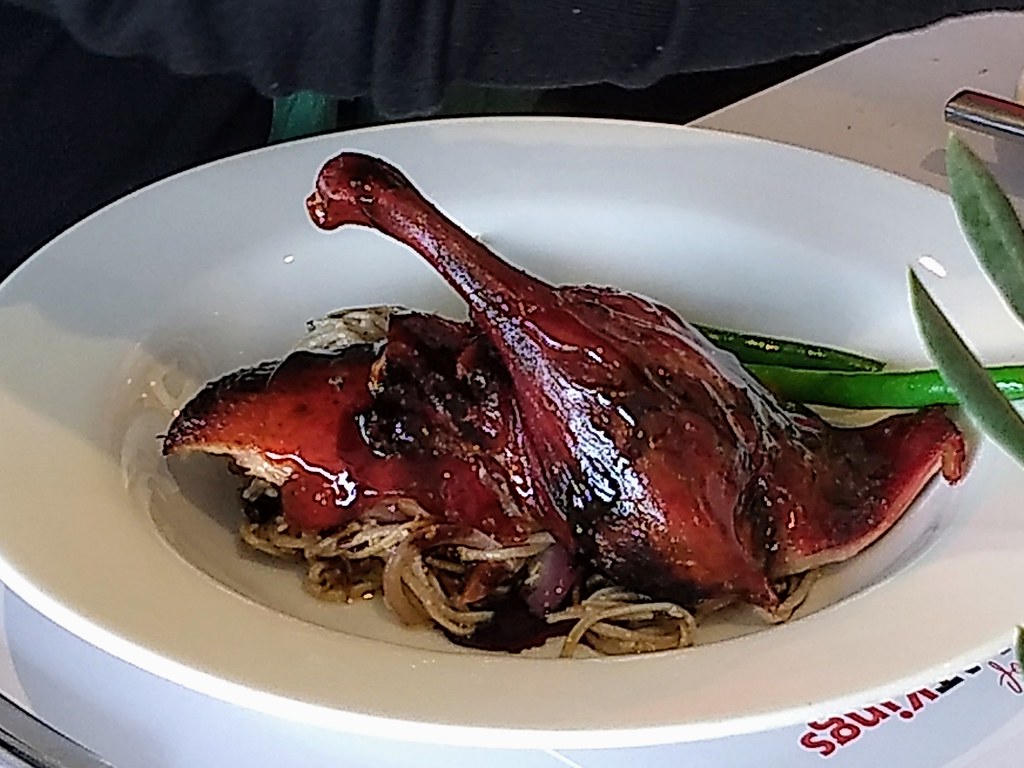
The striking thing about our next stop, Bimbadgen, is undoubtedly the amazing view. In fact, the name itself derives from an indigenous word for 'place of good view'. Bimbadgen is well known for several other reasons too, including world-class concerts in the 'Day on the Green' program and the multi-award winning Esca restaurant. Our lunch choices at Esca are matched with appropriate wines, so the Char Siu Duck, for example, is matched with a Bimbadgen Fiano and the delicious St Agur dessert of figs, lavender, honey and meringue is accompanied by a Merlot.
![]() |
| Char Siu Duck at Bimbadgen |
Our last stop is Leogate Estate, which needs no introduction to wine connoisseurs. The original Brokenback Vineyard was planted under the direction of a syndicate headed by the late wine writer Len Evans, and what is now Leogate Estate produces some of the finest examples of Hunter Semillon, Chardonnay and Shiraz. The wines are so good, in fact, that Leogate's 'The Basin' Reserve Shiraz and 'Brokenback Vineyard' Shiraz have been selected for Qantas First and Business Class wine lists. Needless to say, the wine tasting here was memorable.
The writer travelled courtesy of AAT Kings
Getting there: AAT Kings runs a Hunter Valley Harvest Wine Experience from Sydney. See https://www.aatkings.com/tours/sydney/hunter-valley-harvest-wine-experience/
Visit:
Tintilla Estate
725 Hermitage Road, Pokolbin NSW
Tel: (02) 6574 7093
https://www.tintilla.com.au/
Bimbadgen
790 McDonalds Rd, Pokolbin NSW
Tel:(02)49984600
https://www.bimbadgen.com.au
Leogate Estate
1693 Broke Road Pokolbin NSW
(02) 4998 7499
https://www.leogate.com.au/
See John's new book Against the Odds: surviving the world's worst tsunami and overcoming trauma at www.amazon.com.au/dp/B07CZCHX8S/
Feature supplied by: www.wtfmedia.com.au
June 22, 2019
Croatia: The Small Wonder of Zagreb
John Maddocks finds that Zagreb punches above its weight
Croatia's vibrant capital is a small, sophisticated city often overshadowed by Adriatic superstars such as Dubrovnik and Split. But a new international airport means Zagreb has come into its own as Croatia's main gateway, connected by air to over 50 cities. Tourists are discovering a very laid back metropolis with stunning architecture, fascinating museums and an engaging bar and café lifestyle. It's no surprise that Zagreb was Lonely Planet's 'Best in Europe' as recently as 2017.
After arriving in the early afternoon at my apartment accommodation in the city's centre, I head straight to Zagreb's hub, Ban Jelacic Square. On the way I walk through streets with numerous crowded outdoor cafes. I'm rushing to see as much of this city as possible in the 48 hours before I leave for the coast, but the atmosphere of relaxed, friendly socialising here makes me slow down. I'm liking the place already.
Ban Jelacic Square is the city's meeting point. People are alighting from nearby trams that traverse the city. Friends are meeting here before going to restaurants, bars and theatres. Families and businessmen stroll past the imposing statue of Josip Jelacic, seated on a horse with sword drawn. Jelacic was a nineteenth-century governor who came to symbolise Croatian independence after fighting a losing battle with Hungary. I gaze at the beautiful nineteenth-century buildings bordering the square before crossing on my way to the striking twin spire cathedral nearby. Then I head west and further into the upper town.
The upper town is a precinct of charming ancient streets leading to the Stone Gate, an entrance to the medieval area of the city. The Stone Gate doubles as a pilgrimage site where people come to pay homage to a seventeenth-century painting of the Virgin and Child, supposedly the only section of a wooden gate that survived a fire in 1731. On the way up to St Mark's Church from here I pass a crowd of nuns, a group of Chinese tourists and some of the faithful making offerings. St Mark's is the landmark church famous for its colourful tiled roof displaying a variety of coats of arms. Parliament house and the presidential palace are nearby.
I then walk down past the beautiful Jesuit Church of St Catherine to a point near the thirteenth-century Lotrscak Tower, where there's a wonderful view of the city. The quaint funicular railway takes me on a short trip to the lower town.
Wandering past the monument to Nikola Tesla, one of Croatia's famous sons, I head along the bustling street named after him past cafes and restaurants. Many of the eateries in this lower part of the city are those favoured by locals. There are also some attractive outdoor areas, such as the delightful Zrinjevac Park and the Botanical Garden.
Next morning, after a well-earned sleep, I grab a cheese burek (a filled filo pastry) and takeaway coffee from a nearby bakery and walk to the impressive Croatian National Theatre. Opened in 1895 and built in the Baroque Revival style, the National Theatre is the place to see opera and ballet in Zagreb.
The lower town also has many fine examples of Austro-Hungarian architecture and is worth walking around there for that reason alone. But a standout is Kallina House, a brilliant Art Nouveau structure known as the 'Bat House' because of its distinctive bat motif tiles that decorate the first floor windows.
It's still early in the morning, so I catch a bus to Mirogoj Cemetery. This is a massive necropolis park, with magnificent entrance buildings and tree lined avenues. It's a very peaceful place and compares favourably for atmosphere with Havana's Necropolis Cristobel Colon and Buenos Aires' Recoleta Cemetery.
After contemplating the afterlife, I make my way back to the city and the popular Museum of Broken Relationships. This unconventional storehouse of exhibits is a crowd-sourced collection of artefacts and stories related to 'brokenships' or 'the way we love and lose'. Each personal object symbolises a relationship breakdown and is accompanied by a narrative about how the relationship ended. It's quirky, fascinating and often poignant. You may want to buy a 'bad memories eraser' at the museum's shop.
But I know I'll only have good memories of Zagreb. It's won my heart in two days and I'll definitely want to hook up with this enticing city again.
The writer travelled at his own expense.
Fact File:
Getting there: Emirates and Qatar fly to Zagreb daily from Australia.
When to Go: May to September.
Where to Stay: Five star apartments in Zagreb starting at $75 per night are available online.
Eat:
See John's new book Against the Odds: surviving the world's worst tsunami and overcoming trauma at www.amazon.com.au/dp/B07CZCHX8S/
Feature supplied by: www.wtfmedia.com.au
Images
01. The thirteenth-century St Mark's Church. The tiled roof was added in 1880 to show the coat of arms of Croatia, Dalmatia and Slavonia on the left and that of Zagreb on the right.
02. A funicular connecting the upper and lower areas of Zagreb has existed since 1890.
03. The National Theatre is a neo-baroque masterpiece. It is mainly used for opera and ballet.
04. Sudden unexpected vistas appear in Zagreb's old city, like this glimpse of the cathedral at sunset.
05. Zagreb has numerous museums, but one of the quirkiest and most popular is the Museum of Broken Relationships. It contains a huge collection of fascinating objects from all over the world that relate to the ending of relationships. Very moving and often humorous.
06. Some of the exquisite offerings at Zagreb's innovative Time Patisserie. Zagreb has some of the best cafes, bars and patisseries in Europe.
07. It's worth spending some time wandering in the peaceful Mirogoj Cemetery, Zagreb's massive necropolis.
08. Beautiful expansive parks complement Zagreb's distinctive Austro-Hungarian architecture.
Croatia's vibrant capital is a small, sophisticated city often overshadowed by Adriatic superstars such as Dubrovnik and Split. But a new international airport means Zagreb has come into its own as Croatia's main gateway, connected by air to over 50 cities. Tourists are discovering a very laid back metropolis with stunning architecture, fascinating museums and an engaging bar and café lifestyle. It's no surprise that Zagreb was Lonely Planet's 'Best in Europe' as recently as 2017.
After arriving in the early afternoon at my apartment accommodation in the city's centre, I head straight to Zagreb's hub, Ban Jelacic Square. On the way I walk through streets with numerous crowded outdoor cafes. I'm rushing to see as much of this city as possible in the 48 hours before I leave for the coast, but the atmosphere of relaxed, friendly socialising here makes me slow down. I'm liking the place already.
Ban Jelacic Square is the city's meeting point. People are alighting from nearby trams that traverse the city. Friends are meeting here before going to restaurants, bars and theatres. Families and businessmen stroll past the imposing statue of Josip Jelacic, seated on a horse with sword drawn. Jelacic was a nineteenth-century governor who came to symbolise Croatian independence after fighting a losing battle with Hungary. I gaze at the beautiful nineteenth-century buildings bordering the square before crossing on my way to the striking twin spire cathedral nearby. Then I head west and further into the upper town.
The upper town is a precinct of charming ancient streets leading to the Stone Gate, an entrance to the medieval area of the city. The Stone Gate doubles as a pilgrimage site where people come to pay homage to a seventeenth-century painting of the Virgin and Child, supposedly the only section of a wooden gate that survived a fire in 1731. On the way up to St Mark's Church from here I pass a crowd of nuns, a group of Chinese tourists and some of the faithful making offerings. St Mark's is the landmark church famous for its colourful tiled roof displaying a variety of coats of arms. Parliament house and the presidential palace are nearby.
I then walk down past the beautiful Jesuit Church of St Catherine to a point near the thirteenth-century Lotrscak Tower, where there's a wonderful view of the city. The quaint funicular railway takes me on a short trip to the lower town.
Wandering past the monument to Nikola Tesla, one of Croatia's famous sons, I head along the bustling street named after him past cafes and restaurants. Many of the eateries in this lower part of the city are those favoured by locals. There are also some attractive outdoor areas, such as the delightful Zrinjevac Park and the Botanical Garden.
Next morning, after a well-earned sleep, I grab a cheese burek (a filled filo pastry) and takeaway coffee from a nearby bakery and walk to the impressive Croatian National Theatre. Opened in 1895 and built in the Baroque Revival style, the National Theatre is the place to see opera and ballet in Zagreb.
The lower town also has many fine examples of Austro-Hungarian architecture and is worth walking around there for that reason alone. But a standout is Kallina House, a brilliant Art Nouveau structure known as the 'Bat House' because of its distinctive bat motif tiles that decorate the first floor windows.
It's still early in the morning, so I catch a bus to Mirogoj Cemetery. This is a massive necropolis park, with magnificent entrance buildings and tree lined avenues. It's a very peaceful place and compares favourably for atmosphere with Havana's Necropolis Cristobel Colon and Buenos Aires' Recoleta Cemetery.
After contemplating the afterlife, I make my way back to the city and the popular Museum of Broken Relationships. This unconventional storehouse of exhibits is a crowd-sourced collection of artefacts and stories related to 'brokenships' or 'the way we love and lose'. Each personal object symbolises a relationship breakdown and is accompanied by a narrative about how the relationship ended. It's quirky, fascinating and often poignant. You may want to buy a 'bad memories eraser' at the museum's shop.
But I know I'll only have good memories of Zagreb. It's won my heart in two days and I'll definitely want to hook up with this enticing city again.
The writer travelled at his own expense.
Fact File:
Getting there: Emirates and Qatar fly to Zagreb daily from Australia.
When to Go: May to September.
Where to Stay: Five star apartments in Zagreb starting at $75 per night are available online.
Eat:
- Time Pastry Shop - Ulica Nikole Tesle 14, Zagreb 10000
- La Struk restaurant, Skalinska ul. 5, Zagreb 10000.
- Bistro Fotic, Gajeva Ulica 25, Zagreb 10000
- Nokturno Restoran Gajeva Ulica 25, Zagreb 10000
- Words and images: John Maddock
See John's new book Against the Odds: surviving the world's worst tsunami and overcoming trauma at www.amazon.com.au/dp/B07CZCHX8S/
Feature supplied by: www.wtfmedia.com.au
Images
01. The thirteenth-century St Mark's Church. The tiled roof was added in 1880 to show the coat of arms of Croatia, Dalmatia and Slavonia on the left and that of Zagreb on the right.
02. A funicular connecting the upper and lower areas of Zagreb has existed since 1890.
03. The National Theatre is a neo-baroque masterpiece. It is mainly used for opera and ballet.
04. Sudden unexpected vistas appear in Zagreb's old city, like this glimpse of the cathedral at sunset.
05. Zagreb has numerous museums, but one of the quirkiest and most popular is the Museum of Broken Relationships. It contains a huge collection of fascinating objects from all over the world that relate to the ending of relationships. Very moving and often humorous.
06. Some of the exquisite offerings at Zagreb's innovative Time Patisserie. Zagreb has some of the best cafes, bars and patisseries in Europe.
07. It's worth spending some time wandering in the peaceful Mirogoj Cemetery, Zagreb's massive necropolis.
08. Beautiful expansive parks complement Zagreb's distinctive Austro-Hungarian architecture.
April 30, 2019
The Falkland Islands: A fascinating destination on your Antarctic journey
Join John Maddocks as he wonders at nature and isolated islands.
The black-browed albatross sweeps low over our heads, landing rather elegantly beside its nest, a solid pillar of mud set in tall tussock grass. It joins hundreds of other nesting albatrosses on the steep slope that leads to a dramatic cliff edge on West Point Island, our first landing place in the Falklands.
For nature lovers, this is a significant moment. We're metres from these legendary birds and their nesting neighbours, a large colony of Rockhopper penguins. The albatrosses and penguins show no fear of us and they don't interfere with each other. And the reason we're seeing so many black-browed albatrosses is that the Falkland Islands (or Islas Malvinas to Argentines) is home to eighty-five percent of the world's population, around 680,000 pairs. Little wonder that West Point was once called Albatross Island.
I've been fascinated by the albatross ever since reading Samuel Taylor Coleridge's The Rime of the Ancient Mariner at school, in which the bird symbolises nature. In the poem, an albatross follows the mariner's ship into Antarctic waters, but despite the albatross being regarded as a lucky omen by sailors, the mariner shoots it with a crossbow. From that moment the ship and crew are doomed.
I am reminded of the poem when I sight an albatross soon after our ship sails from Ushuaia on the southern tip of Argentina. Our expedition vessel, heading for Antarctica, is quickly circled by black-browed albatrosses which follow us all the way to the Falkland Islands. But instead of aiming a crossbow at them, I shoot hundreds of photos of these majestic birds as they soar effortlessly and swoop close to the ocean's surface.
Albatrosses can live up to seventy years, often spending months at sea flying for thousands of kilometres and only coming to land to breed, so while we feel privileged to be so close to these amazing seafarers on West Point Island, the comical rockhopper penguins show no respect. These penguins spend a great deal of time waddling between the albatross pillars in an ungainly way collecting bits of grass to build their own nests. Looking at their stocky bodies, it's hard to believe they move like torpedoes under water.
After climbing down to the beach, we encounter a sleeping fur seal who seems oblivious to our presence. Half-a-dozen Magellanic penguins come out of the ocean and make their way up the beach. Some Upland geese walk beside the water with their chicks, unconcerned about a Magellanic penguin strolling beside them. Gentoo penguins gather on grassland behind the dunes. Things seem quite harmonious in this remote part of the world, at least in the animal realm.
But there hasn't been much harmony in the human world. Countries have been fighting over the Falklands for centuries. The French and Spanish made early claims on the islands and later the Germans and Americans showed an interest. But the British have held sway here since 1833 and still do after winning the 1982 war with Argentina. Tensions remain, however, as Argentina continues to claim the islands.
The excellent Historic Dockyard Museum in the capital Stanley has a fascinating gallery devoted to the Falklands War and curating staff are happy to discuss the exhibits, some of which include confronting stories of the inhabitants' war experiences.
With a population of just over two thousand, Stanley is more like a quaint English village of red phone boxes and Land Rovers than a British Overseas Territory's centre of government. Nevertheless, there is a Governor who resides in a rather splendid government house and a functioning Legislative Assembly. And if the locals often seem more British than the Brits themselves, that's because 99.8% of them voted to remain British in a 2013 referendum. Patriotic fervour is obvious in places such as the Victory Bar, which is festooned with Union Jacks and Falklands flags. Here you can chat to friendly locals and have scampi and chips washed down with a warm ale from the Falklands Beerworks.
Stanley is a very welcoming place and, as you walk around, there's a genuine feeling of a far-flung outpost with an overwhelming sense of community. Christ Church Cathedral is a prominent landmark, as is the nearby arch made from the jawbones of blue whales in 1933. The weekly Penguin News keeps inhabitants informed about local and international events relating to the Falklands.
From a traveller's point of view, the Falklands present a rare opportunity to experience exceptional wildlife in one of the planet's last functioning colonial outposts
The writer travelled courtesy of One Ocean Expeditions.
Getting There: Air New Zealand flies to Buenos Aires via Auckland and code shares with Aerolineas Argentinas for flights from Buenos Aires to Ushuaia. www.airnewzealand.com.au
Other One Ocean Expeditions' journeys commence in Chile. Qantas flies to Santiago and code shares with LATAM Airlines for flights from Santiago to Punta Arenas. From Punta Arenas you either fly to the Falklands or commence your sea voyage. www.qantas.com/au/en.html
Cruise: One Ocean Expeditions have cruises to the Falklands, South Georgia and Antarctica commencing as early in the season as October 20, 2019. Visit www.oneoceanexpeditions.com or phone 1300 368 123 or (02) 9119 2228
See John's new book Against the Odds: surviving the world's worst tsunami and overcoming trauma at www.amazon.com.au/dp/B07CZCHX8S/
Story and images (except #6) by John Maddocks
Feature supplied by: www.wtfmedia.com.au
Images
1. Hundreds of black-browed albatrosses and rockhopper penguins nesting on the cliffs.
2. A black-browed albatross and chick on West Point Island.
3. Rockhopper penguins sunning themselves on West Point Island.
4. A Magellanic penguin stroll beside a family of Upland geese.
5. Colourful Stanley, capital of the Falkland Islands.
6. Flags at the Victory Bar leave no doubt about the Falkland Islanders allegiance to Britain. (Image by Jeff Topham)
7. The distinctive whalebone arch at Stanley.
The black-browed albatross sweeps low over our heads, landing rather elegantly beside its nest, a solid pillar of mud set in tall tussock grass. It joins hundreds of other nesting albatrosses on the steep slope that leads to a dramatic cliff edge on West Point Island, our first landing place in the Falklands.
For nature lovers, this is a significant moment. We're metres from these legendary birds and their nesting neighbours, a large colony of Rockhopper penguins. The albatrosses and penguins show no fear of us and they don't interfere with each other. And the reason we're seeing so many black-browed albatrosses is that the Falkland Islands (or Islas Malvinas to Argentines) is home to eighty-five percent of the world's population, around 680,000 pairs. Little wonder that West Point was once called Albatross Island.
I've been fascinated by the albatross ever since reading Samuel Taylor Coleridge's The Rime of the Ancient Mariner at school, in which the bird symbolises nature. In the poem, an albatross follows the mariner's ship into Antarctic waters, but despite the albatross being regarded as a lucky omen by sailors, the mariner shoots it with a crossbow. From that moment the ship and crew are doomed.
I am reminded of the poem when I sight an albatross soon after our ship sails from Ushuaia on the southern tip of Argentina. Our expedition vessel, heading for Antarctica, is quickly circled by black-browed albatrosses which follow us all the way to the Falkland Islands. But instead of aiming a crossbow at them, I shoot hundreds of photos of these majestic birds as they soar effortlessly and swoop close to the ocean's surface.
Albatrosses can live up to seventy years, often spending months at sea flying for thousands of kilometres and only coming to land to breed, so while we feel privileged to be so close to these amazing seafarers on West Point Island, the comical rockhopper penguins show no respect. These penguins spend a great deal of time waddling between the albatross pillars in an ungainly way collecting bits of grass to build their own nests. Looking at their stocky bodies, it's hard to believe they move like torpedoes under water.
After climbing down to the beach, we encounter a sleeping fur seal who seems oblivious to our presence. Half-a-dozen Magellanic penguins come out of the ocean and make their way up the beach. Some Upland geese walk beside the water with their chicks, unconcerned about a Magellanic penguin strolling beside them. Gentoo penguins gather on grassland behind the dunes. Things seem quite harmonious in this remote part of the world, at least in the animal realm.
But there hasn't been much harmony in the human world. Countries have been fighting over the Falklands for centuries. The French and Spanish made early claims on the islands and later the Germans and Americans showed an interest. But the British have held sway here since 1833 and still do after winning the 1982 war with Argentina. Tensions remain, however, as Argentina continues to claim the islands.
The excellent Historic Dockyard Museum in the capital Stanley has a fascinating gallery devoted to the Falklands War and curating staff are happy to discuss the exhibits, some of which include confronting stories of the inhabitants' war experiences.
With a population of just over two thousand, Stanley is more like a quaint English village of red phone boxes and Land Rovers than a British Overseas Territory's centre of government. Nevertheless, there is a Governor who resides in a rather splendid government house and a functioning Legislative Assembly. And if the locals often seem more British than the Brits themselves, that's because 99.8% of them voted to remain British in a 2013 referendum. Patriotic fervour is obvious in places such as the Victory Bar, which is festooned with Union Jacks and Falklands flags. Here you can chat to friendly locals and have scampi and chips washed down with a warm ale from the Falklands Beerworks.
Stanley is a very welcoming place and, as you walk around, there's a genuine feeling of a far-flung outpost with an overwhelming sense of community. Christ Church Cathedral is a prominent landmark, as is the nearby arch made from the jawbones of blue whales in 1933. The weekly Penguin News keeps inhabitants informed about local and international events relating to the Falklands.
From a traveller's point of view, the Falklands present a rare opportunity to experience exceptional wildlife in one of the planet's last functioning colonial outposts
The writer travelled courtesy of One Ocean Expeditions.
Getting There: Air New Zealand flies to Buenos Aires via Auckland and code shares with Aerolineas Argentinas for flights from Buenos Aires to Ushuaia. www.airnewzealand.com.au
Other One Ocean Expeditions' journeys commence in Chile. Qantas flies to Santiago and code shares with LATAM Airlines for flights from Santiago to Punta Arenas. From Punta Arenas you either fly to the Falklands or commence your sea voyage. www.qantas.com/au/en.html
Cruise: One Ocean Expeditions have cruises to the Falklands, South Georgia and Antarctica commencing as early in the season as October 20, 2019. Visit www.oneoceanexpeditions.com or phone 1300 368 123 or (02) 9119 2228
See John's new book Against the Odds: surviving the world's worst tsunami and overcoming trauma at www.amazon.com.au/dp/B07CZCHX8S/
Story and images (except #6) by John Maddocks
Feature supplied by: www.wtfmedia.com.au
Images
1. Hundreds of black-browed albatrosses and rockhopper penguins nesting on the cliffs.
2. A black-browed albatross and chick on West Point Island.
3. Rockhopper penguins sunning themselves on West Point Island.
4. A Magellanic penguin stroll beside a family of Upland geese.
5. Colourful Stanley, capital of the Falkland Islands.
6. Flags at the Victory Bar leave no doubt about the Falkland Islanders allegiance to Britain. (Image by Jeff Topham)
7. The distinctive whalebone arch at Stanley.
February 18, 2018
Tasmania: Breathtaking Bruny Island by Boat
By John Maddocks
Toby can't believe it. This nine-year-old rollercoaster and Wet'N'Wild aficionado is dumbstruck as our fast, custom-built open boat roars out of Adventure Bay on Bruny Island. Toby's eyes widen as the boat engages the 2-3 metre waves, skipping over the surface of the Tasman Sea and occasionally landing with a thump that sends spray over the thirty passengers. And the look on my grandson's face tells me that the exhilaration we're experiencing easily eclipses that of any theme park ride.
Getting to Adventure Bay is easy. Our day trip with Pennicott Wilderness Journeys starts at 8am in Hobart. On the way down to the Bruny Island ferry, our bus driver/guide Nick gives us plenty of information about the towns we pass through and the history of this part of southern Tasmania. After 45 minutes, we reach the small town of Kettering, where we board the vehicle ferry.
Bruny Island is approximately the size of Singapore. The difference is that Bruny Island has fewer than a thousand residents rather than five million. Bruny is beautiful and remote, without the five-star resorts and big hotels found elsewhere. On the way to Adventure Bay we stop at a lookout giving a wonderful view of the Neck, an isthmus joining North and South Bruny. Fifteen minutes later we are eating freshly baked muffins for morning tea in Pennicott's new beachside café.
The staff at Pennicott are quite open about the conditions before we set off, telling us that there is a decent swell running for our trip down the coast to the Southern Ocean. The tidal swell has apparently been increased by the recent 'super blue blood' full moon, and it's well known that the Southern Ocean can be wild at any time.
The choppy conditions don't stop us from cruising beside the majestic sea cliffs, which are among Australia's highest. The cliffs are made of Jurassic dolerite, an extremely hard and distinctive rock. Two albatrosses follow the boat and a dolphin leaps out of the water nearby. We stop for some minutes on the southern side of a massive rock formation known as 'the monument', which stands alone some metres offshore.
As we go further down the wild and enchanting coast, we see many more birds, including an 'improbability' of shearwaters (I learn that an improbability is the name for a group of these birds). Around 50 shearwaters rise from the ocean's surface in front of us, creating quite a display.
We reach the turning point at some rocks known as the Friars, where there are thousands of fur seals. The Friars are known as a 'haul-out' place for seals, where they spend time on land for reproduction and rest. It's a stunning sight to see so many seals gathered in the one area, and all the cameras on board are clicking away frantically.
We have reached the Southern Ocean and the next stop is Antarctica. So we head back up the coast, using the heavy swell to propel us towards Adventure Bay. It's an exciting trip, with plenty of sea spray as our boat surfs the waves.
When we return it's time for a leisurely lunch at the beachside café. The ocean journey has made us hungry. Toby hoes into some fish and chips, while I enjoy homemade pumpkin soup and a salmon and salad roll.
On the way back to Hobart, I reflect on the wilderness cruise experience. I now understand why it has won so many awards, including 'Australia's best tourist attraction' three times. To my mind, this cruise stands out because it's accessible to all ages. And it's fantastic fun.
The writer travelled courtesy of Pennicott Wilderness Journeys
Travel Facts:
Getting there: Drive to Adventure Bay on Bruny Island yourself or take the full day tour from Hobart. The full day tour leaves at 8am and returns at 5.30pm. Ferry crossings, morning tea, lunch and the 3-hour wilderness cruise are included.
Cost: Full Day tour – Adult $225, child 3-16 $165, child under 3 free.
Three-hour cruise only – Adult $135, Child 3-16 $85, child under 3 free.
More Information: https://www.pennicottjourneys.com.au/
Contact: (03) 6234 4270
Email: info@pennicottjourneys.com.au
Feature supplied by: www.wtfmedia.com.au
Captions:
1. The fast, open boats are ideal for viewing the coastline. (John Maddocks)
2. Amazing rock formations feature on Bruny Island. (John Maddocks)
3. The rock cliffs of Bruny Island are some of the highest in Australia, (John Maddocks)
4. The monument is a standout on the Bruny Island coast. (Pennicott Wilderness Journeys)
5. Seeing fur seals up close is a feature of this wilderness cruise. (Pennicott Wilderness Journeys)
6. Powerful custom-built boats provide great access to the rugged coastline. (Pennicott Wilderness Journeys)
Subscribe to:
Posts (Atom)
Support Traveloscopy - Support Responsible Travel.
Traveloscopy is a freelance journalism enterprise supporting the tourism and travel industries. We aim to encourage people to travel thoughtfully and responsibly and also support sustainable initiatives within the travel sector. You can help us cover our operating costs, even if in just a small way.
Last 30 Days' Most Popular Posts
-
Anybody who’s been shopping in any of the major Asian cities will know exactly what I’m talking about. The market in fake designer goods is ...
-
david ellis BLINK while you're looking at a map of the Pacific and you'll miss it, this tiny dot whose few vi...
-
An historic Kuala Lumpur landmark is returned to former glory, reviving the romantic jazz era of the 1930s. Roderick Eime relives a lit...
-
Sharon Catlin "We're still open for business and visitors are welcome to stay or stop for refreshments and a meal." (Tony W...
-
Anglophile Peter Needham beckons you to explore Britain in winter and reveals some little-known advantages of travel in the chilly season. ...