google.com, pub-5161388013621688, DIRECT, f08c47fec0942fa0 Traveloscopy Travelblog Traveloscopy Travelblog

June 16, 2019

Star Wars Galaxy’s Edge: Visit Planet Batuu on your next holiday


Space travel may be beyond the reach of most of us, but not when you visit Disney’s newest multi-million-dollar attraction, Star Wars Galaxy’s Edge. Ardent Star Wars fan, Roderick Eime, travels to a galaxy far, far away.

Star Wars themed attractions have been a part of Disneyland for more than 20 years, but this all-new, 5.5 Hectare, intricately-detailed, precinct within the main Disneyland theme park is a whole new level of ‘out of this world’. Based on the far Outer Rim planet of Batuu, it is named the Black Spire Outpost after the two massive pinnacles that overshadow the complex where the Millenium Falcon is parked.

Conceived in 2014, soon after Disney acquired Lucasfilm outright, work on Galaxy’s Edge began in 2016 and opened to the public amid great fanfare in May 2019.

Of course, the legions of Star Wars fans were out in force for the opening and soon reports began circulating about the many experiences, merchandise, food and characters contained within the 50,000 square metres of custom rockwork and plaster.

As a long time fan of the famous trilogies, the first thing I noticed was that this is not a location recognisable from any of the movies. Insiders tell me that much of what we see here at the Black Spire Outpost will be revealed in the next - and last - instalment of the 40-year saga, Episode IX: The Rise of Skywalker.


Be prepared for random ID checks (Richard Harbaugh/Disney Parks)

That said, random photo-opp appearances are made by well-remembered characters. Chewbacca, the giant furry Wookiee from Kashyyyk is mobbed by adoring fans when he lopes into the Souk-like marketplace. Out in the plaza, two patrolling Stormtroopers conduct random ID checks on unsuspecting guests while Rey twirls her fighting staff for amazed onlookers.

To me, an unabashed sci-fi nerd with remnants of my childhood imagination still intact, it was the intricate detail of the entire set that impressed me most. Every nook and cranny is themed including the light fittings, water bubblers, trash cans, washrooms and Disney staff who, quite accurately, are called ‘cast members’ with whom you don't just chat, but interact. Each has their own back story and role in this unfolding drama into which you have landed.

Kylo Ren arrives in his mysterious starfighter (Richard Harbaugh/Disney Parks)

As I wandered the the expansive set, it was astonishing to stand beside full-size replicas of such iconic vehicles as A-Wing and X-Wing Starfighters, Luke’s Tatooine speeder and, of course, the massive Millennium Falcon. But there is one hyperspace starfighter that will have fans doing a double-take. Just what is that strange ship parked across the way? My research revealed it to be a First Order TIE Echelon and it now plays its own part in the Black Spire performance as a set piece for the arrival of Kylo Ren as he searches for a resistance spy that could be you!

Okay, so now you have found yourself in this alternate universe, what is there to do?

  • Embark on an immersive virtual mission aboard the Millennium Falcon where you and five co-pilots must capture valuable cargo to aid the resistance
  • Travel on the interactive virtual reality ride, Rise of the Resistance, which will be open by September 2019.
  • Shop for Star Wars souvenirs and soft toys like Kowakian Monkey-Lizards and Porgs in the marketplace or obtain rare collectors’ objects like legacy lightsabers or rare kyber crystals from Dok-Ondar's Den of Antiquities. You’ll have to barter with Dok-Ondar too if you want a deal.
  • Enjoy themed food like Mustafarian Lava Rolls, Smoked Kaadu Ribs or Fried Endorian Tip-yip at Docking Bay 7 Food and Cargo. The famous Batuu blue and green frozen milk is available outside at a special dispensery.
  • Over-21s can enjoy special alcoholic beverages at Oga’s Cantina.
  • Build your own custom radio-controlled Astromech Droid Unit in the Droid Depot. There are nearly 280,000 possible combinations for constructing an R-series or BB-series astromech droid using all the available pieces.
Savi's Workshop, where you can build your own custom lightsabre (Joshua Sudock/Disney Parks)

  • Construct your own personalised lightsaber at Savi’s Workshop where there are more than 120,000 possible combinations to ensure yours is a true one-of-kind weapon.
  • Explore the minute details of the Black Spire Outpost and see if you can find such ‘easter eggs’ as a Dianoga nicknamed “Tiny”, the character depicted in the Toydarian Toymaker shop sign, a stuffed wampa or a tiny version of Han Solo's Mobquet M-68 landspeeder. There are many of these hidden all around the outpost and the junk depot is a great place to start.
  • Install the smartphone app which will give you special abilities to interact with objects and installations within the attraction.


A twin theme park is also under construction at Disney's Hollywood Studios in Walt Disney World Resort in Orlando, Florida. It will be open from September 2019.


Getting There:

Virgin Australia Holidays has released Star Wars packages for Australians planning their trip to Star Wars: Galaxy’s Edge at Disneyland Resort California. For more information, visit: www.virginaustralia.com/starwars


June 11, 2019

Egypt: 3500 years of history in Luxor


Len Rutledge explores some of the world's greatest temples, and what could be the world's richest archaeological site, and suggests go to Luxor in Egypt. Luxor is an hour's flight up the Nile from Cairo. 

Luxor grew out of the ruins of Thebes the capital of Egypt from about 1500 to 1000 B.C.

Luxor is suffering badly at the moment because tourism has dramatically collapsed. This means it is a great time to visit. Hotels have cut prices, tour guides are readily available, crowds are nowhere to be seen and everyone is going out of their way to be friendly, helpful and courteous. Safety is on everyone's minds and I must say my wife and I felt completely at ease everywhere we went.

We had gone to Luxor to see two massive temples – the Temple of Amun at Karnak and the Temple of Luxor - as well as the attractively-named Valley of the Kings. Each met our expectations and we then discovered there was much more to see and do.

The Temple of Amun (Karnak Temple)

This complex of three temples built over a 2000 year period is probably the biggest temple on earth. Our expectations were high and as we wandered the site we became more and more impressed. The stillness of the whole place with its stone columns soaring against the brilliant blue sky was breathtaking.

The surfaces of the grand courtyards are all covered by fine carvings. The scale and detail is staggering. I thought of the vision, the work and the investment that went into this huge structure and then was told that all this could not even be seen at the time by the public. It was only for priests, royals, and the gods.

A Millennia later the public entered. We saw marks on the columns where Roman soldiers sharpened their swords, and early Christian images of Mary and Jesus are carved on the ancient pillars like graffiti. Many of the statues have had their noses cut off by the Romans to destroy the Pharaohs rebirth system,

The Luxor Temple

The Luxor Temple is all about the great warrior pharaoh, Ramses II even though it was started 100 years or more (around 1380BC) before his reign. Two 25m pink granite obelisk built by Ramses once stood before the entrance gateway but today only one remains; the other stands in the Place De La Concorde in Paris.


The temple has been in almost continuous use as a place of worship. During the Christian era, the temple's hypostyle hall was used as a Christian church. Then for many centuries the temple was buried and a mosque was eventually built over it. This mosque was carefully preserved when the temple was uncovered and forms an integral part of the site today.

Originally an avenue lined with sphinxes ran the entire 3 kilometres between the Luxor and Karnak Temples. This avenue is currently under excavation and reconstruction and you see a short completed section near Luxor Temple.

The Valley of the Kings

In about 1600 B.C. there was a big change in the style of royal tombs. Until then, kings were buried in pyramids, but these were consistently being robbed, which meant kings were waking up in the afterlife without their precious earthly possessions. So, rather than mark their tombs with big pyramids, the kings started hiding their tombs underground in the valleys on the west side of the Nile.

Each buried king was provided with all the necessary things that would provide a comfortable existence in the afterlife. The condition of the 63 tombs that have been discovered and the details on their walls is incredible after all these centuries. Most are decorated with scenes from Egyptian mythology.

The entry ticket to the valley allows you to visit three tombs out of several that are open but some require additional payment. Photography is not allowed in the tombs.

The Hatshepsut Temple

This is perhaps the most spectacular structure on the west bank. The mortuary temple was only discovered about 150 years ago and there is still some on-going restoration work under way. The temple rises out of the desert in a series of terraces that from a distance merge with the sheer limestone cliffs behind.


This temple was built by Queen Hatshepsut, the first known female monarch, who ruled for about two decades. Her reign was one of the most prosperous and peaceful in Egypt's history. When Thutmose III followed her as pharaoh, he had all evidence of her reign destroyed by erasing her name and having her image cut from all public monuments, even within this temple.

Although unknown for most of history, in the past 100 years her accomplishments have achieved global recognition and her stunning mortuary temple has become one of the most visited structures on the West Bank.

Need to Know

There are few facilities for visitors on the West Bank. Most stay in Luxor and travel to the West Bank by bus or on a tour. All the major Luxor hotels offer tours.

Luxor is in the desert and the surroundings are hot and dusty. You need water and perhaps a snack when you are visiting most of the sights.

www.LenRutledge.com

Words: Len Rutledge Images: Phensri Rutledge

https://www.facebook.com/ExperienceGuides /

https://www.youtube.com/channel/UCX5HUmGP1lR2aoscn3O8P2Q

Feature supplied by: www.wtfmedia.com.au

Images

1. Karnak Temple

2. Entrance to Luxor Temple

3. Hatshepsut Temple

4. The author at Hatshepsut Temple

June 02, 2019

Opera Houses Around the World


Len Rutledge finds that world famous opera houses are great attractions for travellers.
No matter where we travel there is a good chance that we will see some impressive buildings. In Europe it may be palaces and castles, in Asia there are spectacular temples while in North America there are towering skyscrapers. I have travelled to see impressive bridges and railway stations and have recently added opera houses to my list. Some of these latter buildings are some of the most glorious buildings in the world.
Look at these few examples taken at random from around the world. When you add the Royal Opera House, London, the Vienna State Opera, the Metropolitan Opera House, New York, the Teatro Colon, Buenos Aires, the Teatro Fenice Venice, and our own Sydney Opera House, it makes an impressive list. Each is worth a visit.
Palais Garnier in Paris
This is one of the most famous opera houses in the world, partly because it was the setting of the novel The Phantom of the Opera and the subsequent films and popular musical. It was built in the 1860s and it was the primary home of the Paris Opera and its associated Paris Opera Ballet until 1989, when the modern Opera Bastille opened. The Palais Garnier is now used mainly for ballet.
The building was the most expensive in Paris during its era and some regard it as a masterpiece although this opinion is not universally shared. It is close to some of Paris's most famous department stores so it makes a nice contrast to the shopping 'palaces'.
Teatro alla Scala in Milan
This challenges Paris as the most famous opera house in the world. It was built in the 1780s and most of Italy's greatest operatic artists, and many of the finest singers from around the world, have appeared here.
Building expenses were covered by the sale of boxes, which were lavishly decorated by their owners, and like most of the theatres at that time, La Scala was also a casino. In 1943, La Scala was severely damaged by bombing. It was rebuilt and reopened in 1946. The theatre underwent a major renovation from 2002 to 2004. The stage was entirely rebuilt, and an enlarged backstage allowed more sets to be stored.
La Scala has hosted the first productions of many famous operas, and had a special relationship with Verdi. He conducted his Requiem there in 1874 and the theatre hosted his penultimate opera, Otello and the premiere of his last opera, Falstaff.
Oslo Opera House
The spectacular Oslo Opera House is the home of The Norwegian National Opera and Ballet. Construction started in 2003 and was completed in 2007, ahead of schedule and under budget. The Opera House won the 2009 European Union Prize for Contemporary Architecture.
A 50 minute guided tour in English lets you walk out onto the Main Stage, or visit the costume workshop or scene painting room, while you learn about the architecture, stagecraft, opera and ballet from the guides.
Bolshoi Theatre Moscow
This is an historic theatre in Russia, which holds ballet and opera performances. The main building of the theatre, rebuilt and renovated several times during its history since 1821, is depicted on the Russian 100-ruble banknote.
A new stage was built in 2002, and this together with a restored 17th-century building, two rehearsal halls, and artists' recreation rooms forms a single theatre complex. From 2005 to 2011 the theatre was closed for restoration which included an improvement in acoustics, and the restoration of the original Imperial decor.
The Bolshoi Ballet is probably the most renowned ballet company in the world and it is by far the largest with more than 200 dancers. Tchaikovsky's ballet Swan Lake premiered at the theatre in 1877 while other regulars on the Bolshoi repertoire include Tchaikovsky's The Sleeping Beauty and The Nutcracker, Adam's Giselle, Prokofiev's Romeo and Juliet, and Khachaturian's Spartacus.
The Royal Opera House Stockholm
Kungliga Operan has been the Swedish national venue for opera and ballet since 1773. You can visit here as a member of the audience at one of the performances or take a guided tour. The building is located in the centre of Sweden's capital and is connected to the Royal Palace by a bridge.
The original opera house was demolished to make way for the present building which opened in 1899. It is a majestic neo-classical building with a magnificent gold foyer and elegant marble grand staircase leading to a three-tiered auditorium which seats 1,200. Interestingly, 45 minutes before most opera and ballet performances, a 15-minute introduction to the evening's performance is held in the Gold Foyer.
Words: Len Rutledge   Images: Phensri Rutledge
Images;
1.    Paris
2.    Milan
3.    Oslo
4.    Moscow
5.    Stockholm 

May 23, 2019

Ultimate Driving Tours on pole for Monaco


An Australian-based luxury tour company has grabbed pole position in Monaco – a sold-out crowd for its most popular event, a visit to this weekend's iconic Formula One race.

Clients of Ultimate Driving Tours were able to choose to enjoy their F1 Grand Prix spectator duties as a stand-alone experience (May 23-26), or combine their stay in the beautiful principality with a four-day European Supercar Tour through France, Switzerland and Italy, before or after the event.

Ultimate Driving Tours first offered a driving tour including the Monaco F1 event back in 2012. This year, a total of 48 drivers have booked out the two tours, with another 50 people opting to join them just for the race weekend. All will enjoy the race from a privately chartered superyacht moored in a prime location in Port Hercules, beside the track.

This is a capacity crowd for this tour combination, one of the most popular of Ultimate Driving Tours' range of more than 10 tours, which take clients to destinations in Australia, Europe, America and the UK. All tours allow clients to drive a selection of the world's best cars.

For this month's tours, participants have also chosen from a list of popular optional extras – adding on an evening with Australian F1 star Mark Webber and/or driving a real F1 car on a closed circuit.

"We were sold out for the Grand Prix six months ago," says Ultimate Driving Tours CEO, Anthony Moss. "It's so popular that next year's Grand Prix is filling fast, with only limited spots available, while on current indications, the related driving tours either side of the 2020 Monaco Grand Prix will be sold out next month."

Mr Moss says many of his clients describe visiting the Monaco Grand Prix as a 'bucket list' item. Adding a driving tour either side is the cream on top.

"They say they are surprised by what incredible value they get for the price. Four days driving the world's best cars on the world's best driving roads and staying in amazing hotels paired with excellent food and wine.

"People want to reward themselves for their efforts in their life. We see parents that have children who have graduated or moved out of home, businessmen and women who have sold companies and others who just have a passion for cars."

Clients can certainly indulge that passion to excess with Ultimate Driving Tours. Thanks to the company's special partner arrangements, they can get behind the wheel of vehicles such as Ferraris (458 Spider and 488 GTB) and Lamborghinis (Huracan and Aventador), as well as the Porsche 911 GT3 and GTS, the Aston Martin DB11 and the McLaren 720S.

Until this year, the iconic Monaco Grand Prix was the only F1 event on Ultimate Driving Tours' calendar, but the company is now offering a package to the Italian Grand Prix(September 6-8), which is already nearly 80 per cent sold out.

Clients wanting to book a driving package with Ultimate Driving Tours can combine it with any other plans in Europe. The tours are created as exclusive end-to-end luxury travel experiences with every detail arranged by the company's team of European specialists who can recommend many other things to do and see, and do the bookings too.

Ultimate Driving Tours was born from a passion for all things motor-related, and an appreciation for the finer things in life. The company specialises in exclusive and unforgettable supercar driving tours, motorsport packages and track events, as part of a luxury travel experience.

More information is available on the website:  www.ultimatedrivingtours.com

May 19, 2019

Relive Riverboat History on the Murray River aboard a paddle wheeler


Words: Roderick Eime

Australia’s riverboat history is a colourful one. What began as a challenge between two entrepreneurial merchants in the infant colonies, turned into a thriving industry for over half a century.

19th-century paddlesteamer 'Queen' loading cargo (Port Adelaide Railway Museum)

Spurred on by a prize of 4000 pounds offered in 1851 by the governor of South Australia, Sir Henry Fox Young, William Randell and Francis Cadell started the romantic and hectic era of paddlesteamers along the Murray River with their own modest vessels. Within a few years, around 250 vessels were plying the river, carrying general goods, wheat, wine and other produce to market.

But the river, like any other, was fickle and prone to periods of high and low water. Boats were often stranded for weeks on end with perishable cargo on their decks, and before a series of planned locks could be completed, the river trade was overtaken by road and rail. Many boats were abandoned where they lay, left to rot in the mud.

Even though the river trade may have almost died out, the tourist demand kept the big paddlewheelers afloat. Taking a few days for a leisurely cruise along the Murray River has been a tradition for the best part of a century - with comfort and refinement gradually increasing to its peak with the PS Murray Princess, the largest and grandest vessel yet.

For example, two of the busiest ports from the heady days of 19th Century paddlesteamers, Mannum (SA) and Echuca (VIC), keep the tradition alive with both restored and replica vessels taking part in regular re-enactments’ and tourist cruises. Here is a quick summary of the ways and where’s you can relive the glory days of Murray River paddle steamers.

South Australia

Mannum, founded by William Randell around 1850 expressly to service his paddle boat empire, is still the home of the famous 110-year-old PS Marion. This delightful historic vessel still operates cruises.


The century-old PS Marion (supplied)

For information, see www.psmarion.com or telephone +61 8 8563 2720 or +61 407 937 487

Also based at Mannum is the impressive sternwheeler, PS Murray Princess, the biggest paddlewheeler ever to operate on the Murray and claimed to be the second largest in the southern hemisphere. Carrying 120 passengers at a leisurely 6 knots, the PS Murray Princess operates 3-, 4- and 7-night itineraries between Mannum and Blanchetown, depending on river levels. Excursions include wine tasting, history and museums, a sheep station and Aboriginal heritage.

For information, see https://www.murrayprincess.com.au/ www.captaincook.com.au or telephone +61 2 9206 1100

PS Murray Princess,  the largest paddlewheeler ever to operate on the Murray River and the largest paddlewheeler in the Southern Hemisphere (SeaLink) 

Murray Bridge in South Australia is another historic river port where you can take a short day cruise aboard the modern Captain Proud or a 2- or 5-night cruise aboard the 1982-built, 40-passenger Murray Expedition (formerly MV Proud Mary)

See www.rivermurraycruises.com.au or www.captainproud.com.au

The Riverina port town of Renmark is known as the oldest irrigated township in Australia and was also a major player in the river trade. Today the paddlesteamer, PS Industry (1910) calls Renmark home.

See https://www.facebook.com/PSIndustry.Renmark/

At the mouth of the great river is the town of Goolwa, home port to the century-old PS Oscar W. Formerly work barge C24, Oscar W was restored as a paddlewheeler and after a colourful career on the Murray it now serves exclusively as a day-cruiser. Goolwa offers a double treat for history buffs because it is also the terminus for the ‘Cockle Train’, a steam locomotive operating between the wharf and Victor Harbour.

See http://www.oscar-w.info/cruises.html and www.steamranger.org.au

Victoria

The twin towns of Echuca Moama boast the largest fleet of paddlewheelers in the world including the oldest wooden-hulled paddleboat, the 1866-built PS Adelaide and the TV star, PS Pevensey (1910). Other vessels have included PS Alexander Arbuthnot (1923), PS Emmylou (1980 replica with a 1906 engine), PS Hero (1874) PS Canberra (1912) and PS Pride of the Murray (1924).

Port of Echuca (VisitNSW)

While one or more of these vessels may be under maintenance or restoration by their volunteer staff, there will be still a choice of several vessels on which to cruise. A good time to visit Echuca Moama is during one of their annual festivals like the Celtic Festival (March), Winter Blues (July) or the American Iron Heritage Truck Display (September).

For a full listing of events, activities and cruises, see www.echucamoama.com

https://www.echucamoama.com/things-to-do/experience-our-attractions/paddlesteamers

Trivia: In 1984, a 6-part television miniseries, All the Rivers Run, based on a historical novel by the Australian author, Nancy Cato, was filmed in and around Echuca. It starred veteran Australian actors John Waters, Sigrid Thornton, Charles ‘Bud’ Tingwell and Gus Mercurio. The starring vessel was the century-old PS Pevensey renamed ‘Philadelphia’ for the series.

Mildura is one of the largest cities on the Murray River and today is a bustling rural centre with modern, sophisticated accommodation and dining. Paddlesteamers Melbourne (1912) and Rothbury (1881) operate regularly from the wharf with Melbourne departing twice each day as it has done continuously for the past 40 years. The Mildura fleet also includes the modern replica Mundoo.

For further information on the Mildura fleet, see www.paddlesteamers.com.au

Swan Hill Pioneer Settlement is a recreated 19th century river township that includes the genuine historic river vessel, PS Pyap (1896) as part of its activities.

See www.pioneersettlement.com.au

New South Wales
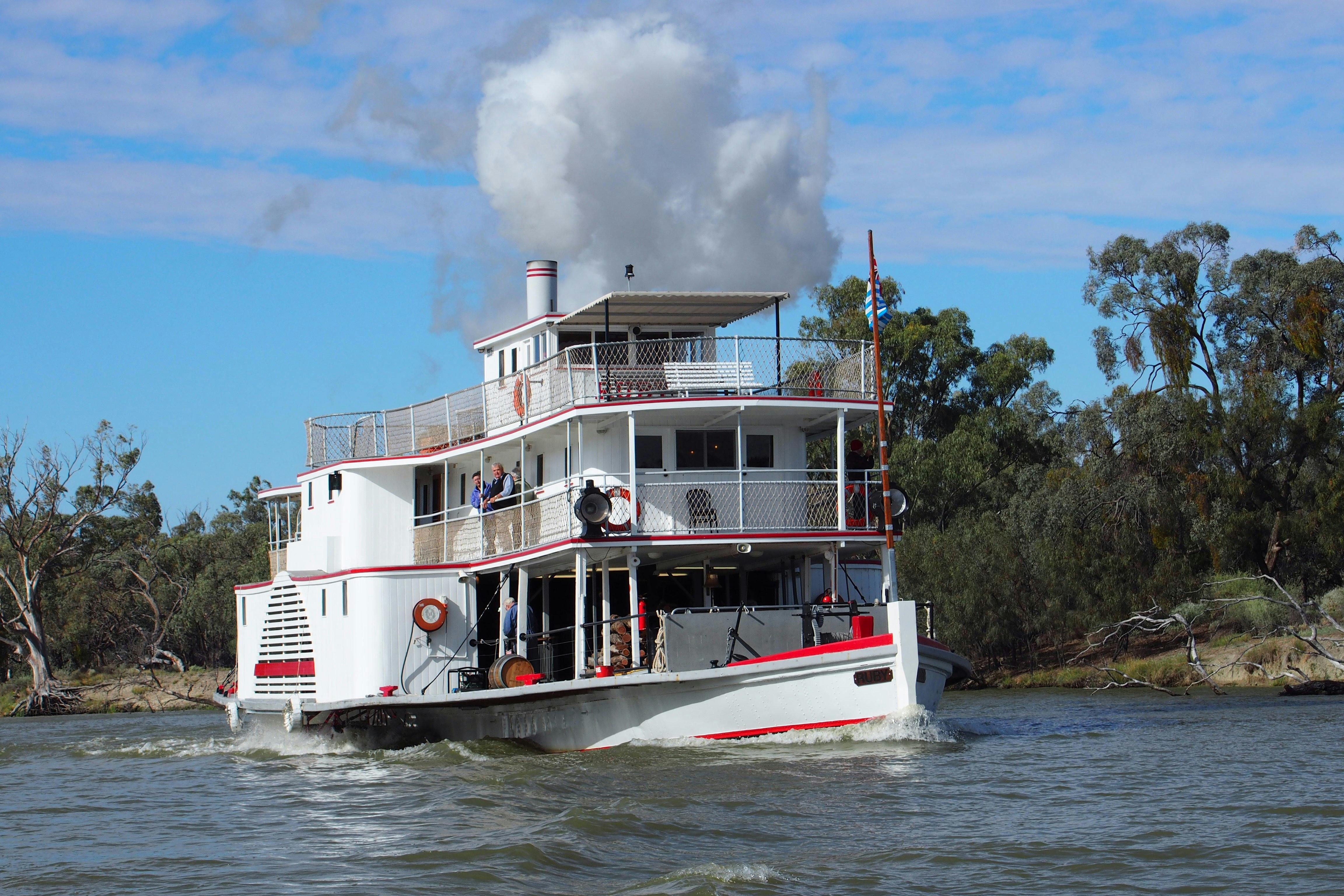
As the Murray River forms the border between New South Wales and Victoria, it was natural that the northern state (or colony as it was before 1900) be part of the busy river trade. The town of Wentworth is the home port for the PS Ruby (1907) after it was presented to the community following restoration in 1996. One of the last remaining vessels purpose-built for passengers, Ruby is operated by volunteers on a cruise schedule based on demand and does not have onboard overnight facilities.

PS Ruby (Visit NSW)

See http://www.murrayriver.com.au/ps-ruby-wentworth-inc-1241/ for scheduled cruises

The many surviving and restored Murray River paddlesteamers are operated and lovingly maintained by squads of volunteers, reflecting the great affection held for the vessels themselves and the history they represent. Cruise aboard one of these magnificent antique vessels and share in the romance of Australia’s greatest river.

For a summary of all cruising and activities along the Murray River, see www.murrayriver.com.au http://www.murrayriver.com.au/river-cruises/


May 14, 2019

Bucharest: Ready for a post-Soviet future


Len Rutledge finds that Bucharest now welcomes all visitors

"There is no such thing as vampires," I'm told on my first afternoon in Bucharest, Romania. "Dracula is our country's biggest brand, but he is fake." My wife and I had not come to Bucharest to find vampires. In fact, we were uncertain why we had come but a few days later it was clear. We had come to see a place once known as the "Paris of the East" which had suffered badly under five decades of communism but was now re-emerging as a welcoming place for all visitors.

Bucharest is unlikely to win any awards for beauty or style, but it surprised us with its cosmopolitan vibe and energy. Although much of Romania's capital was bulldozed by the communists, the old town survived and is abuzz with bars, cafes and restaurants.

Nicolae Ceausescu, the megalomaniacal ruler for many years, ripped out a huge area of the historical centre — 30,000 houses, schools, and churches — to create his dream city with wide boulevards, stone-faced apartment blocks, and gurgling fountains modelled, it is said, on Pyongyang, North Korea. That is still there but thankfully so too are some wonderful art nouveau buildings, ancient churches and monasteries, lush parkland, lakes and elegant boulevards.

Romania joined the EU in 2007, but it is not in the Eurozone. Instead, we changed our money to Romanian lei and received a pleasant surprise with the result. That is another reason to stay longer than planned.

We started our sightseeing by visited the indisputably jaw-dropping Palace of the Parliament, a gargantuan concrete folly and an embodiment of communist-era might. Ceausescu bled the nation dry to erect the second-largest building in the world (after the Pentagon) and the huge annual maintenance bill is still a drain on resources. It finally opened in 1994 — five years after Ceausescu was executed in a bloody revolt.

We toured in a small group through a fraction of the 1100 rooms. Most are empty to this day but the ones we saw were lavishly decorated. Finally, we moved on to the balcony in Union Hall to take in the view down Unirii Boulevard. To visit, you need to have your passport with you and there is high security.

Palace Square was where, in 1989, Nicolae Ceaușescu realised that the 80,000 people that had gathered had not come to hear his speech but to start a revolution. He began to deliver his speech but he was quickly airlifted by helicopter from the rooftop. He and his wife were executed three days later and the square was renamed Revolution Square.

Around the square are the tall white Memorial of Rebirth Obelisque, the former Royal Palace which is now the National Museum of Art of Romania, and the mid-19th century Roman Athenaeum opera house where the Romanian Philharmonic Orchestra plays.

The National Museum of Art is separated into a European Gallery, with an impressive quota of old masters, and a National Gallery of Romanian art. Just north, the Roman Athenaeum is arguably the most beautiful building in town, and it's worth visiting to sample its acoustics and to gawk at its opulence. This building is a Romanian symbol and appears on a 5 Lei note.

Art of a different kind is seen on the streets. There seems to be graffiti everywhere but as one local put it," They're just buildings being 'spruced up' with graffiti."

One of the surprising delights was roaming around without a plan. Fresco-filled churches hide in corners where they escaped communist building projects. The majority of the population are Eastern Orthodox, and you will find Orthodox churches dotted throughout the city. Tiny but beautiful Stavropoleos Church is in the Old Town while St Apostles' Church and Antim Church, are both near Unirii Boulevard.

For something different we strolled in the gorgeously landscaped Cismigiu Park and watched the boats on the lake. There is a chess and backgammon retreat for seniors, the most seats I have ever seen in a park, and buskers for entertainment. This is just one of several nice parks and gardens.

In another park, mills, parts of churches, old homesteads and agricultural structures are all on display in the National Village Museum, an open-air delight on the banks of Herăstrău Lake. It is comprised of some 300 buildings. It is a very long walk from the Old Town but several buses run past the museum.

Romanian food is not well known outside the country so we went to Caru' cu Bere, the Old Town's most famous beer hall with gorgeous painted vaults to try the Romanian national dish; cabbage rolls stuffed with mincemeat, with a side of polenta. It was excellent. We later tried this dish in other places and always found it enjoyable.

Bucharest was a surprise. After several days we were still finding new things to see, new places to eat and drink (the Old Town has hundreds of restaurants and bars), and new experiences to enjoy. We could happily go back there.

www.LenRutledge.com

IF YOU GO

There are no direct flights from Australia to Bucharest but there are connections from many European capitals.

Australian passport holders do not need a visa for a tourist visit of up to 90 days.

Words: Len Rutledge Images: Phensri Rutledge

Feature supplied by: www.wtfmedia.com.au

Images

1. Palace of the Parliament
2. Revolution Square
3. Orthodox Church of Sfantul Anton-Curtea Veche
4. Old Town Restaurants

May 11, 2019

Unlocking Australia’s Convict and Criminal Past


Words: Roderick Eime (originally commissioned for Tourism Australia)
Australia was built on the sweat of convict labour. Beginning with the arrival of the first fleet in 1788, transported lawbreakers were the backbone of the construction and work force for the new colony that would become this great country over a century later. Bridges, public buildings, roads and civil engineering were all heavily reliant on the use of prisoners on hard labour.

Many convicts were set free in Australia and went on to make lives for themselves and even fortunes. Some rose to high office while others served the country as architects, doctors and merchants. Once upon a time, Australians would seek to erase their convict heritage, but now it’s seen as a ‘badge of honour’ for those tracing family roots.

One of the lasting monuments to Australia’s convict past is the many gaols and penitentiaries still standing, most in use up until very recently. The UNESCO World Heritage Convention has even recognised sites such as Port Arthur (TAS) and Norfolk Island as being of ‘cultural significance’. Some are even touting for new clients, inviting visitors to stay over and experience a night in a cell.

Here are some of our more interesting, lesser-known examples and the special visitor experiences they offer.
VIC: Old Melbourne Gaol
Victoria’s oldest surviving gaol, Old Melbourne Gaol started its ghastly life in 1839 and was subject to constant remodelling and reworking until it finally closed in 1929. Located right in the heart of Melbourne, it’s easily reached on foot or public transport.
This grisly building was the scene of 135 hangings, including the infamous bushranger, Ned Kelly in 1880 at the tender age of 25. His death mask and revolver are on display.

Ned Kelly being led to the gallows

This old lock-up is full of history and, many believe, ghosts. In 1972 it was re-opened as a public museum after being placed on the National Trust of Australia’s heritage list in 1957. Today the gaol offers one of the most complete visitor offerings from simple self-guided tours to the ‘arresting’ watch house experience where guests are locked up in a simulated custodial event. At night, take part in a spine-chilling hangman’s tour or even a ghost-hunter tour with authentic paranormal investigators as your guides.
NSW: Maitland Gaol
When Maitland Gaol, in NSW’s Hunter Valley, closed in 1998, it was Australia’s longest continually operating prison with a history of 150 years. It too incarcerated some of this country’s most repugnant inmates including the convicted murderers Ivan Milat, John Travers, underworld hitman and thug, Neddy Smith, as well as the notorious bank robber and escape artist, Darcy Dugan.
Its unpleasant past included 16 hangings, many of them public, as well as floggings and riots.
Today the old heritage-listed gaol is a true multi-function centre offering venue space for private and corporate events, functions and even laser skirmish. It is regularly used in film and television shoots as well as exhibitions and is the current home to Australian Museum of Clothing and Textiles.
Tours include audio/self-guided and themed tours conducted by ex-warders and ex-inmates highlighting the colourful history and escapes. There are school tours, psychic tours, private tours and even sleepovers in C Wing under full lockdown. This is definitely not for everyone.
WA: Fremantle Prison
One of the UNESCO-listed convict-era sites, Fremantle Prison was opened in 1852 after having been built by convicts requested by the free settlers expressly for the purpose of labour. One woman and 43 men were hanged here, the last in 1964.
Penal transportation was relatively brief in WA, being only from 1850 to 1868, but the gaol quickly filled to its 800 inmate capacity and continued to house both male and female prisoners until 1970 and males only until it closed permanently in 1991.
One of the cool and spooky things about Fremantle Prison is the kilometre of tunnels that were dug beneath the building to reach the limestone-filtered water that was used to supply the growing colony as well as ships in port. These tunnels now have their own tour and won’t suit the claustro- or acrophobics. School and group tours are available too as well as a creepy torchlight tour that takes in the morgue, gallows and whipping post.
SA: Adelaide Gaol and The Old Mount Gambier Gaol


Along with Maitland, Adelaide also claims to have the longest continuously operating prison in Australia. Built in 1841, just five years after the establishment of the free settler colony, it housed over 300,000 prisoners until closure in 1988 and remains one of the two oldest buildings in South Australia. Between 1840 and 1964, 45 men and one woman were executed by hanging. No transported convicts were ever brought to South Australia.
Since closure, the gaol has been managed by the Adelaide Gaol Preservation Society Inc. and both guided and self-guided tours are run. No gaol tour would be complete without a ghost and paranormal tour – and Adelaide runs these three times a week.
Down south in the sleepy town of Mount Gambier, is the Old Gaol. Built in 1866 from local stone, it closed in 1995 and now offers one of the most accessible overnight cell experiences. For just a few dollars, it provides quirky backpacker-style accommodation and is a talking point for your travel blog. One execution was recorded there in November 1871.
QLD: Boggo Road Gaol
From 1883 until 1989, Annerley (Boggo) Road was the site for men’s and women’s prisons, the latter being built on 'modern' penological principles of the 19th century which ensured its heritage listing today. Currently the site is under repair and tours are not expected to recommence in the short term.
TAS: Penitentiary Chapel
Away from the better known Port Arthur and right in Hobart CBD, is the Penitentiary Chapel historic site. Originally built to provide the growing number of convicts with a place of worship and religious instruction, it soon took on a macabre second life with the installation of an execution yard and solitary confinement cells. Curiously the punishment cells were directly beneath the chapel and tortured prisoners often interrupted the services and 32 executions were performed in the ‘holy’ yard. Guided day and night (ghost) tours take place every day.


May 05, 2019

Khao Lak - Thailand beach holiday hotspot


Words: Len Rutledge
It was once one of the fastest growing tourism areas in Thailand. Then it was hit by a massive tsunami. Now it is a charming retreat from the hustle of Phuket. With excellent accommodation options, several interesting attractions, and a growing reputation in the trade, Khao Lak is proving to be an appealing destination for many Australians.

Before you go, you need to understand the pros and cons of this destination. The pros are nice beachside resorts, white sandy beaches, a laid-back vibe ideal for relaxing, and some enjoyable attractions. The cons are the spread-out nature of the area, a lack of tourist transport, little nightlife, and limited shopping opportunities. Perhaps the last two are actually cons!

Here is what makes the area appealing to me.

Little Amazon

At the Little Amazon entrance. The sign says "Welcome to Thailand river jungle version of the Amazon. Here you will experience ancient Banyan trees, exotic animals, and other beauties Thai nature has to offer." Perhaps this is overstating it a little bit but the one-hour trip in small inflatable canoes with a paddler/guide was fascinating.

You cruise slowly along a little river which winds gently through the swamp and you can see monkeys, egrets, monitors, mangrove snakes, and mud crabs. The huge banyan trees with their spreading roots are quite spectacular and majestic.

Unfortunately, our trip was dampened by a heavy tropical downpour but in fine weather this would be a photographer's paradise.

Old Takua Pa town

Well known to local tourists but largely shunned by foreigners, the old Sri Takua Pa district, located about 7 km south of the main Takua Pa town, features picturesque old architecture that comes from Takua Pa's glory days as a tin mining and port centre.

Both sides of the main Si Takua Pa Road that bisects the old town are dotted with period buildings conspicuous by their Sino-Portuguese architecture, Chinese shrines and tea houses. The town seems to house mainly elderly people who sit chatting in front of their homes or walk or ride bicycles to the local market.

It is very much a laid-back attraction but if history or architecture have any interest to you, it is easy to spend several hours wandering around absorbing the scene.

Khao Lak beaches

The Khao Lak beaches are the main reason why many people choose this tranquil area of Phang Nga Province as their holiday destination. Khao Lak Beach is the most southerly developed strip of sand and this gives its name to the whole area from here to Banglut Beach many kilometres to the north. Stately trees line the edge of the beach and a headland blocks this beach from its neighbours to the north.

The most peopled beach is Nang Thong Beach - La On Village. The half-dozen resorts that front the beach have sea-view pools so some guests don't ever make it all the way to the sand.

Bang Niang, immediately to the north, is the second most populous beach. There are a few longtail boats here, while resorts overlook the beach, and basic-but-cheap Thai restaurants and massage huts are found nearby.

Further north again, Khuk Khak Beach, with only a couple resorts tucked among the pine trees and palm groves, runs north to Pakarang Cape.

Police Boat Memorial

Nothing brings home the power of the 2004 Tsunami better for me than seeing Police Boat 813 that was swept 2 kilometres inland and is still sitting on site, now as a memorial. This boat and another that sunk killing all on board was anchored about a kilometre out at sea as a protection to members of the Royal Family who were holidaying in Khao Lak at the time.

Adjacent is a two-storey International Tsunami Museum created by an American university in association with the local authority. A visit here helps to put things in perspective and your entrance fee and anything you buy contributes to help the local community as most of the benefits go to victims.

The Ban Nam Khem Tsunami Memorial Centre is further north near the coast in an area that suffered very badly. Unfortunately, this doesn't appear to be well managed and some visitors are quite disappointed in the faded photographs and cracking concrete.

Accommodation

We stayed for several nights in the excellent Khao Lak Laguna Resort which fronts the Andaman Sea. The resort has villas and extremely large well-furnished rooms which are set in delightful gardens. There are several restaurants, a spa with excellent service, two beachfront swimming pools, gym, sports facilities and a lounge with evening entertainment.

We thoroughly enjoyed our time there and we expect that the same could be said for several other resorts in the same general area. There is some budget accommodation in Khao Lak but this tends to be away from the beach.

Getting to Khao Lak

There are buses and vans from Phuket International Airport. It takes about 45 minutes to reach the main part of Khao Lak. There are also buses travelling the long route 4 from Bangkok.

Words: Len Rutledge Images: Phensri Rutledge

www.LenRutledge.com

Feature supplied by: www.wtfmedia.com.au

Images

1. Khao Lak Laguna Resort

2. Little Amazon

3. Pld Takua Town

4. Police Boat Memorial


5. The Beach Front


Support Traveloscopy - Support Responsible Travel.

Traveloscopy is a freelance journalism enterprise supporting the tourism and travel industries. We aim to encourage people to travel thoughtfully and responsibly and also support sustainable initiatives within the travel sector. You can help us cover our operating costs, even if in just a small way.

Last 30 Days' Most Popular Posts