google.com, pub-5161388013621688, DIRECT, f08c47fec0942fa0 Traveloscopy Travelblog Traveloscopy Travelblog

February 27, 2017

Struth! Hookers Lips land judge in hot water


PUCKER UP TO THESE IF YOU DARE

David Ellis

TALKING in one's sleep can be fraught with problems – as many a night mumbler will attest.

And a mate who just recently hit the jackpot in fatal sleep-talking revelations, says his wife was probably well-justified in waking him at 2am to demand an explanation as to whose were those "hooker's lips" he was mumbling so enthusiastically about at that unholy hour…

And remarkably when he started blurting out, she accepted his explanation instantly, rolled over and went straight back to sleep. The reason? This mate's both a gardening fanatic and flower show judge, and just the day before his sleep-talking episode, had been invited to adjudicate at a show in America that would include an almost Holy Grail of exotic plants, Psychotria Elata.

For those who don't know, this highly unique plant is a native of Colombia, Ecuador, Costa Rica and Panama in Central and South America, and is hugely popular as a potted gift in the United States because of its fiery red bracts – that look just like they could be, as one of its common names suggests, pouting red "Hooker's Lips."

And here was my mate dreaming and sleep-talking of the day he would soon be heading to the US-of-A, to help judge a show of such exotic "Hooker's Lips," and which, by the way, are not just highly popular patio-plants in the 'States for their bizarre shape and colour, but also for their ability to attract butterflies and hummingbirds.

And sleep-talkers.


PHOTO CAPTION:

[] LITTLE wonder butterflies and hummingbirds pucker-up to South America's "Hooker's Lips" plants. (Gloriousmind.com)

February 06, 2017

Splashing out at Puttin’ On The Ritz


David Ellis

WHAT do you do when it's your first Christmas Day on duty as Concierge at London's very swanky The Ritz Hotel, and a V-VIP Guest tells you he has a longing for the salty waters of famed Brighton Beach, but that being mid-winter it's too cold – and can you be a good chap and fetch a few pails of the stuff for him to plunge into in his room's bathtub?

In the case of Michael De Cozar you, of course, say "Yes, Sir, of course."

Now Chief Concierge and in his 44th year at The Ritz, Michael still remembers it like yesterday. "One of our porters named Freddie had brought his little Morris Minor motor-car to work that day, so we loaded it up with 25-litre pails and sent him off on the 200km round-trip down to Brighton.

"It took him two-and-three-quarter hours in each direction, and what anyone on the beach on Christmas Day and the middle of winter must have thought at the sight of Freddie in his Ritz uniform, shoes and socks off, pants rolled up and trudging across the pebbles of Brighton fetching pails of seawater, is anyone's guess!


"And I still wonder to this day whether our guest added hot water – or did he just slide into his Brighton seawater bath cold after we'd filled it up for him?

"Whatever, he did thank us most effusively later, telling us how wonderful it had made his Christmas Day."

Anyone beat that for Putting On The Ritz?


PHOTO CAPTION:

[] MICHAEL De Cozar… now Chief Concierge at London's very swanky The Ritz Hotel, and good reason to remember his very first Christmas Day on duty at the hotel's Concierge Desk. (The Ritz Hotel)

[] TAKING the plunge – a guest at London's The Ritz Hotel asked for his bathtub to be filled with Brighton sea water, and the hotel of course obliged –  despite the need for a 200km, six-hour car trip. (The Ritz Hotel)


January 29, 2017

Hydro Majestic's global dining palette in the Blue Mountains


Saucy tales, exotic opulence and the odd celebrity demise. The Hydro Majestic Hotel in the Blue Mountains sits alongside the Hotel Ritz Paris, Raffles Singapore and Claridge’s London as legendary havens of mischief and luxury

With staff from around the world welcoming waves of international tourists in a distinctly Australian location, the Hydro Majestic also represents the modern face and cuisine of Australia – as it has for more than a century.

The status of the original Blue Mountains party palace as the grandest of the grand hotel in the region was restored when current owner Escarpment Group unveiled its $35 million refurbishment in October 2014.

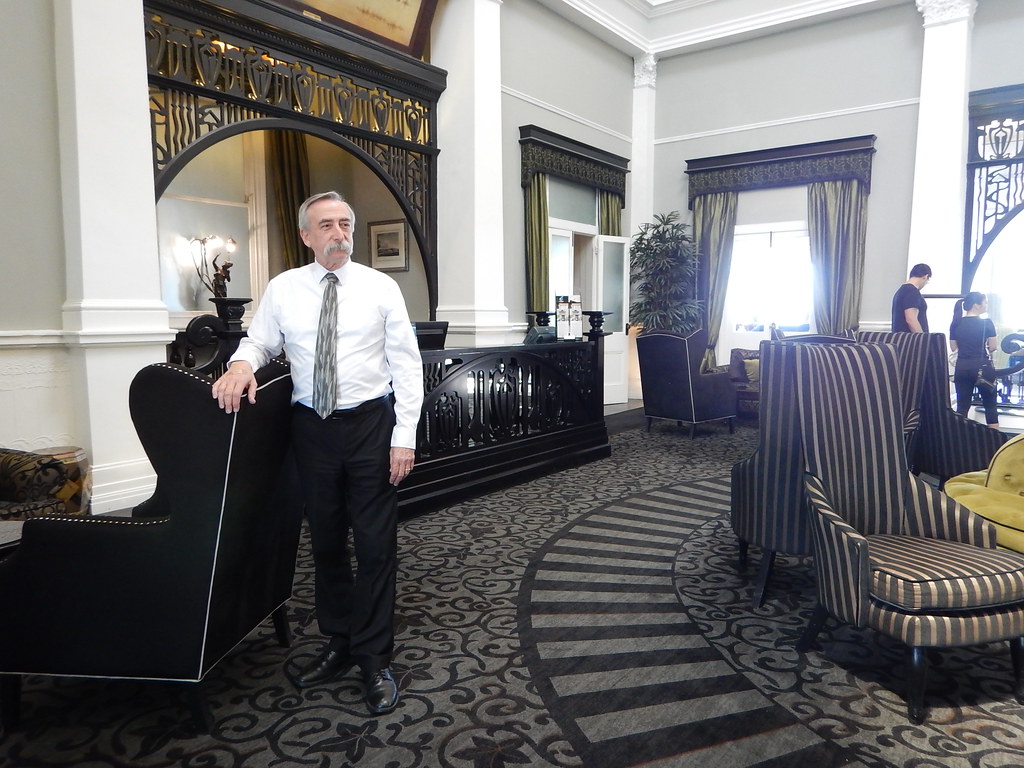
Concierge, Patrick Verity, greets guests in the restored casino lobby

The spectacular Casino Lobby was stripped back to show off that stupendous dome prefabricated in Chicago and imported by original Hydro Majestic owner, department store doyenne Mark Foy.

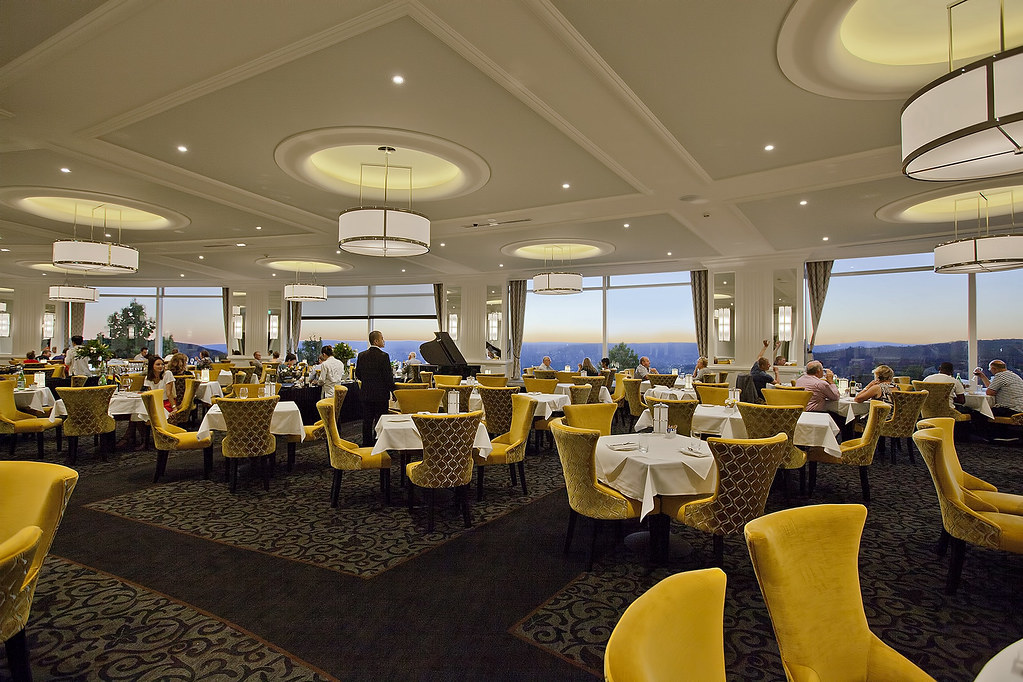
The Wintergarden Restaurant where one takes high tea (traditional or Eastern) is bedecked in understated gold and white elegance with enormous windows giving a breathtaking view over the Megalong Valley.

There’s the Majestic Ballroom with its beautiful vaulted ceiling, the revamped Boiler House CafĂ© in the old pump house and the sophistication of black and chrome in the Belgravia accommodation lounge.

But the best way to appreciate the full magnificence of the Hydro Majestic, the building, the history and the gob-smackingly gorgeous location on the edge of the escarpment, is to stroll along the (in)famous Cat’s Alley hallway, cocktail in hand, and watch the sunset over the Megalong Valley. The golden tendrils seep down the blood red walls, lighting up the peacock feathers and richly furbished lounges, and bring the original artworks of blood sports to life.

Foy, was a visionary, an ambitious and remarkable one, creating the hotel on a mountain top against all odds. Soon the fortunate, the famous, the fabulous, even the infamous, flocked to the Hydro Majestic from around the globe.

With regular festivals and events including the Roaring 20s Festival in February, Escarpment Group has returned the flounce to the old girl’s skirt so the Hydro Majestic is once again the most flamboyant showgirl of Australia’s first tourist destination.

The latest event was a seven-course degustation featuring traditional dishes from global locations infused with local flavours served by staff from around the world, heralds a modern era of theatrical dining for Mark Foy’s ``Palace in the wilderness’’

Dishes such as Creole-style braised short rib, southern grits, collard greens and corn tamarillo salsa obviously originated from distant shores. However, the ingredients were sourced from a 100-mile radius around the hotel.

Rounding off the gastronomic event with lamingtons was the shared food link to Australia.

Wintergarden Restaurant

It could be said that the Hydro Majestic represents the modern face and cuisine of Australia – as it has for more than a century.

Escarpment Group general manager Ralf Bruegger said: ``The Hydro Majestic has always embraced cultural diversity, not because its first owner Mark Foy was politically correct but because he genuinely loved people of all races, their culture, art and food – just as we do today.

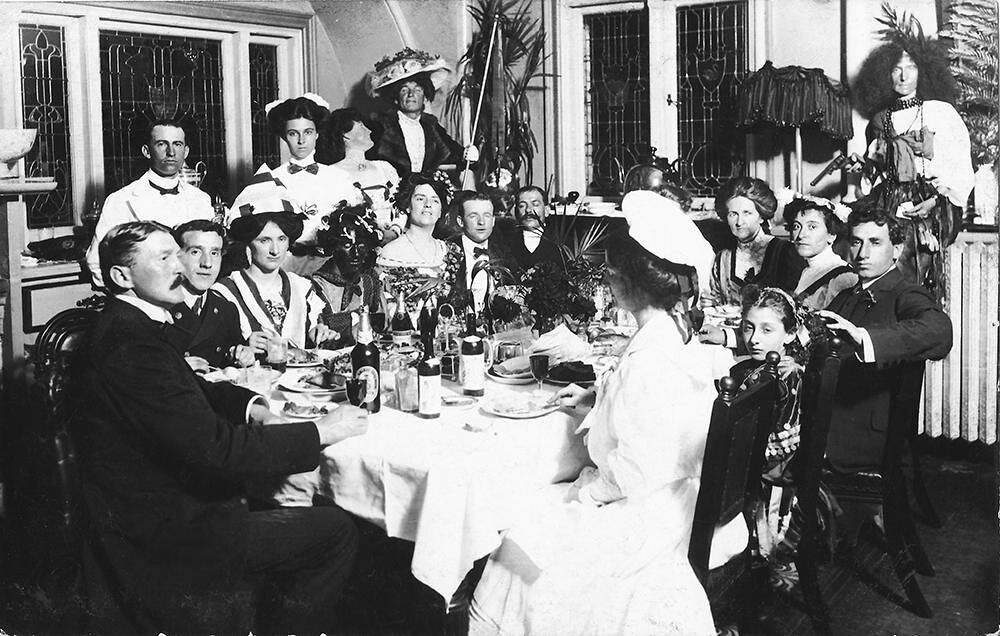
``In fact, what is seen as progressive, even outrageous today, has always been normal at the Hydro Majestic. I mean, what was normal for a man who liked to dress in his wife’s clothing and held cross-dressing parties for his friends?’’

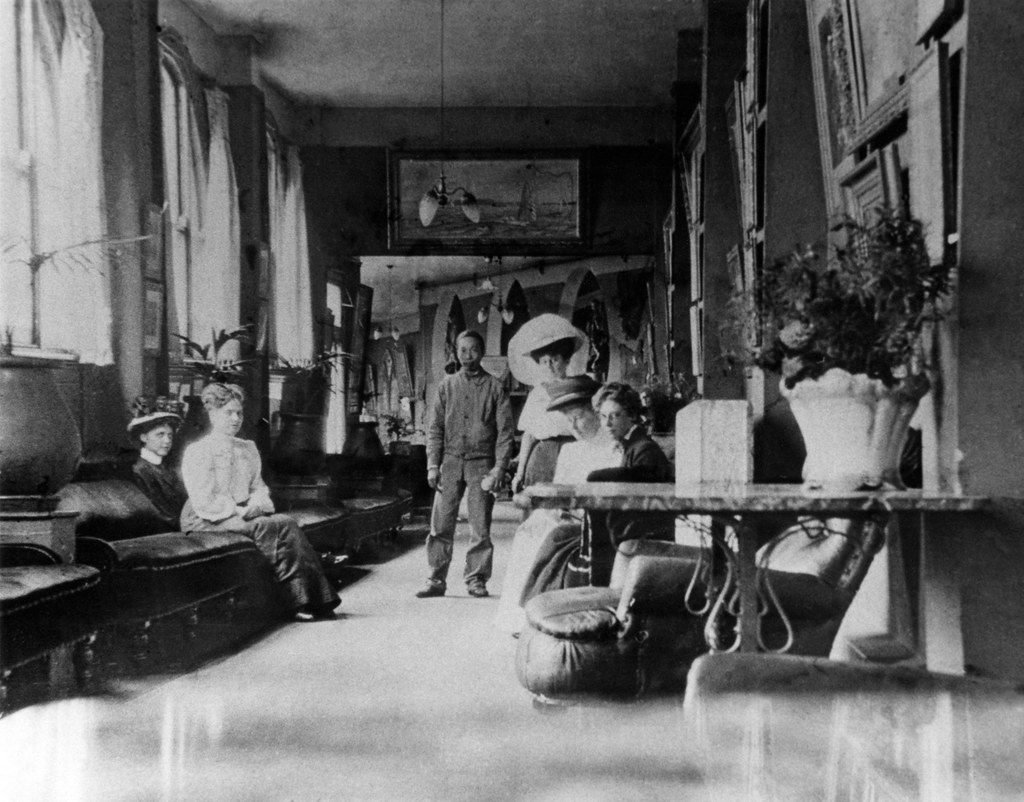
With the means to satisfy his every whim, the well-travelled Foy had the famous hotel dome pre-fabricated in Chicago and shipped to Australia. Dr George Baur of the Shoeneck health spa in Switzerland was hired to devise and supervise a program of diets and weird and wonderful treatments. Turkish coffee at the Hydro Majestic was served by Turkish waiters, Chinese tea by Chinese waiters.

Ladies in "Cat's Alley" with Chinese waiter
Louie (``Charlie’’) Goh Mong was just one of many Chinese migrants who reverted to their traditional skills post-Bathurst gold rush era around the turn of the 20th century and worked as butlers, cooks, nannies, maids and produce suppliers to inns, guesthouses and manor houses across the Blue Mountains during that time.

Charlie worked as a cook at Foy’s Sydney home and managed the mayhem at the Hydro Majestic for 35 years.

Today, staff from 16 language groups work at the Hydro Majestic including English, French, Canadian, Russian, Chinese (all dialects), Portuguese, Vietnamese, Spanish, Italian, Indonesian, Thai and more. Mr Bruegger is German and head chef Mate Herceg has a Croatian background.

``People visit the Hydro Majestic from all over the world and we must understand and accommodate their cultural needs,’’ Mr Bruegger said. ``In an internationally renowned destination such as the Blue Mountains it is expected of us and certainly received by our guests in all other mature tourism regions of the world.’’

Go to hydromajestic.com.au or phone (02) 4782 6885 for bookings and more information about the Hydro Majestic Hotel.

January 26, 2017

Alaska Inside Passage Cruise with Princess


INSIDE PASSAGE WITH PRINCESS CRUISES

You might think ocean cruising consists solely of lazing about in a deckchair, a fruit cocktail in hand, doing little more than watch the water slosh about the ship’s swimming pool. But I have to report that cruising the Inside Passage, between Canada and Alaska, is non-stop action.

Crown Princess in Alaska's Glacier Bay (supplied) 

Whatever your choice of cabin, be it port or starboard, upper or lower deck, there’s an unwritten law of the sea which, simply put, says the most enthralling sights of the cruise inevitably occur when you are least ready for them. It means you spend little time actually relaxing in your cabin and a great deal of time executing the cabin-to-deck dash, only to catch a departing glimpse of what your more prescient fellow passengers will no doubt describe as the most singularly thrilling experience of their lives.

So it was with whales while cruising aboard the Crown Princess, one of a fleet of six graceful Princess Cruise Line ships that ply the Inside Passage between Vancouver and Seward during the warmer Alaskan months.

By September, on the last cruise of the season, it was autumn and the weather overcast. The sun was on holiday down south and daytime temperatures of around 9°C were considerably lowered by wind chill. The ship's pool was therefore deserted and deckchairs were strapped into neat stacks. Passengers working off a surfeit of breakfast made regular brisk circuits around the decks.

We had on board an effusively enthusiastic cruise naturalist called Brent. One of his many sizzling natural passions was the humpback whale. I was dreamily contemplating passing glaciers from the comfort of my cabin when the alarm sounded. "Whales, whales, three o'clock", came the urgent bellow over the ship's intercom. "Humpbacks, whooo boy!" yelled Brent from the bridge.

The slamming of cabin doors and the patter of feet told me I was not the only one caught offside. Grabbing my camera, I charged headlong for the uppermost deck as Brent's electric commentary urged me on to greater feats of nimbleness and speed than I'd imagined possible.

"Look at them go ... oh, look at that, a beautiful, double fluke re-entry!" he gabbled, like a demented Olympic diving judge. "Now a breach, wheee boy! And another breach, oh my gawd! Absolutely fantastic!"

I burst on deck, heaving and panting. Passengers were pressed four-deep along the starboard rail, seeming to lend the 70,000-ton liner a slight list. Brent's voice barked again. "More humpies, one o'clock!" I was leaping up and down like a Samburu warrior trying to see over the collected heads. "Fabulous. That's made my trip!" exclaimed one extremely short, bespectacled man pressed up fast against the rail.

"Nine o'clock, nine o'clock! A breach, a breach!" Brent was now beside himself. I was beside myself! That was my side of the ship! Had I stayed put I'd have had a balcony seat to myself.

We rushed to port, where I rucked and mauled my way to the rail. And thar she blew! A glistening leviathan hurled itself ecstatically from the frigid water off Point Adolphus, fins akimbo, its enormous barnacled body on display for a fraction of a second before crashing back into the green seas in a burst of spray.

Inside Passage cruising can be as exhilarating as it is energetic. During our seven day cruise I worked out regularly, rushing about the ship, propelled by an urgent voice describing significant but fleeting moments in this vast, preternatural landscape of mountains, snow and ice. Considering the avalanche of food that flowed day and night from the ship's kitchens this regular exercise was essential.

Daily consumption aboard ship included 1400 kg of meat, 380 kg of fish, 730kg of vegetables, 150kg of pasta, 1100 litres of coffee and more than 3000 delectable little pastries. This resulted in 39,000 dirty plates a day and nearly 13,000 dirty glasses. The 27 crew members on the continuous wash-up squad remained out of sight below decks, if not entirely out of mind.

In College Fjord we saw no less than seven glaciers, including Vassar, Harvard and Yale. The Captain carefully put the ship within 400 metres of one gigantic ice flow. We clung to the rails, peering from our wondrous vantage point into the deep, hypnotic blue of highly compressed ice, hoping to see the calving of an iceberg.

The rule on glacier calving is simple: once you hear the crack, the ice has already fallen! So never avert your eyes! I heard several sharp retorts but I saw little, perhaps caught offside again. But I did witness spectacular calving off Margerie Glacier as the ship probed deep into Tarr Inlet off Glacier Bay.

Alaska cruising is not for the faint-hearted. The most popular shore excursion of our trip was glacier-hopping by helicopter high above Juneau, a dramatic aerial plunge into a primeval realm of forbidding, craggy peaks and ice-bound valleys. More sedentary shore options included fishing trips, nature walks and cultural tours.

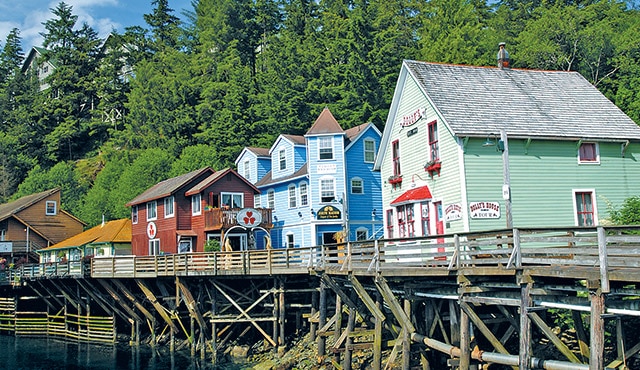
Ketchikan (supplied)

Another option was souvenir hari-kiri. The old salmon-fishing town of Ketchikan, the neat Alaskan capital of Juneau and frontier-flavoured Skagway each boasted unique attractions but shared a common blight, the excess of souvenir shops weighed down with a repetitive range of memorabilia. This, however, didn’t deter most of the passengers who seemed delighted to discover shopping nirvana at latitude 58°N.

Alaska has an exceptional "official state fossil", the woolly mammoth. Its frozen bones, found in the glacial ice fields, swiftly make their way through the hands of carvers and scrimshaw artists into outlets along the cruise ship corridor. They compete for attention with carved walrus tusks, polished polar bear teeth, crude jade carvings, Alaskan opal pendants and necklaces of "black diamond" haematite.

Other souvenirs include ulu knives, crystal and porcelain figurines, fluffy animal toys, tins of smoked salmon and an endless unfolding of slogan-rich T-shirts. The most intriguing indigenous artifact was undoubtedly those moose droppings, dipped in varnish and fashioned into earrings. Or how about moose poo swizzle sticks?

Escape from all this was found in the Naa Kahidi Theatre in Juneau where I watched enactments of the myths and stories of the Tlingit, Haida and Tshimshian people. The town’s lively Red Dog Saloon also provided refuge from souvenir overload, as did Skagway's Red Onion Saloon where cruise ship musicians joined local players in an afternoon jazz session.

Riding the rails above Skagway towards White Pass I had a Gordon Gecko moment, almost believing that greed might be good. The lust for gold certainly propelled people to insane heights of determination. One example is the staggering feat of engineering and hard labour that created the White Pass & Yukon Railway. The line was made by chiselling, hacking and tunnelling through solid rock. It crosses narrow canyons on spidery trestle bridges and overcomes formidable natural barriers on its steep haul up to Whitehorse and the old Yukon goldfields beyond.

The ride to Whitehorse and back to Skagway was a four-hour excursion of exceptional scenic beauty with the chance of spotting some wildlife, but only for quick sighted. A bear glimpsed lumbering up one side of the track disappeared within seconds into the surrounding bush.

More wildlife may be seen from the Midnight Sun Express which runs between Fairbanks and Anchorage via Denali National Park, hauling luxury railcars with panoramic views up top and stylish restaurant below. The trip can be a land tour add-on to a cruise.

Fairbanks was at its most beautiful, displaying an autumnal royal flush of luminous golden birch forests. The rich palette of summer's final shredding, a riot of amber and carmine, ochre and sienna, was reflected in the glassy smooth surface of the Chena River. A light powdering of snow called terminal dust, heralding the end of autumn, had settled on the mountains.

The M/V Discovery paddlesteamer churns along the Chena on a carefully prepared excursion that provides a whiff of life in the frozen north. At a model native Athabascan village two Eskimo college students, one Yup'ik, the other Inupiak, gave a delightfully frank, funny and informative commentary on the traditional lifestyle of their grandparents.

I ended my trip at the Anchorage Museum of History and Art where I was fortunate to see an exhibition of ancient Indian and Eskimo masks. It was a fascinating visual insight into local history and culture and a fitting finale to my Inside Passage adventure.

© Rob Woodburn


January 23, 2017

Struth! World's largest meat pie


Swiss precision sees meat pie record

FOUR Swiss chefs have found themselves on the front pages of their nation's newspapers, simply because they cooked a meat pie in the lead-up to Christmas.

And obviously not just any meat pie.

Because just like we'd do at home, their's had a pastry base filled with meat and other goodies (in this case beef and pork, bacon, garlic, onion and red wine, ) and on coming out of the oven sported a topping of crispy pastry all nicely folded and tucked to save any dribbling and spilling.

But any resemblance between ours and theirs ends-up there, for the Swiss job was a whopping 160cm long, 78cm wide and 11cm thick… and scaled-in at 86.75kg. (If you've not yet come to grips with metrics, that's 5ft 3ins long, 2ft 6ins wide and 4.3ins thick… and 191 pounds.)

All big enough to put the pie's makers, from the Swiss hotel management school Ecole Hoteliere de Lausanne, in the books of the World Record Academy for the world's largest-ever traditionally one-piece meat pie.

After a day to assemble and 40 hours to bake, the massive pie was put on public showing – and then cut up and given away to charities for the needy and homeless at Christmas.


PHOTO CAPTION:

[] ANYTHING but pie-eyed, these four Swiss chefs created the world's largest-ever traditionally one-piece meat pie, and after showing it off gave it away to the needy and homeless. (Hoteliere de Lausanne)

December 20, 2016

Tiger spotting in India


RANTHAMBORE NATIONAL PARK

(Now open in August and September)


For many decades the hunting preserve of the Princes of Jaipur and offers a fascinating combination of crumbling monuments, living temples, wild beauty, and your best chance to spot a wild tiger. Set within a high, jagged escarpment, Ranthambhore Fort has towered over the park's forests for nearly a thousand years and has witnessed many a bloody combat -- even the Mughal emperor Akbar fought a battle for supremacy here in the 16th century. Inside the fort, lie a number of ruined palaces, step wells, and a celebrated Ganesha temple visited every year in September by two million pilgrims. But it is the forests, that lie shimmering in the gorges below, scattered with more ancient crumbling monuments that attract the foreign pilgrims, who come during the winter months to catch a glimpse of the mighty Bengal tiger. The Park generally remains closed from July to September however the Rajasthan Forest Department has just issued a decree to reopen Zone 6 to 10 in the months of August and September as well.

Ranthambore is accessible from Jaipur via a 4 hour drive and a 5.5 hour train ride from Delhi. There is a range of accommodation from the very luxurious Aman Resorts, The Oberoi Vanyavilas to the environmentally sensitive Khem Villas.

December 19, 2016

Mandurah and fresh Blue Swimmers – Delicious

It's that time of year when a vast water playground, just an hour's drive from Perth, becomes a frenzy of activity as fishermen – both professional and amateur – come to feast on blue swimmer crabs (sometimes called 'manna' or 'blueys'.

John Newton jumped aboard a crabbing and eco adventure vessel on its first crab hunt of the new season in the Peel-Harvey estuary and its waterways, which are recognised as twice the size of Sydney Harbour.

It was early on a Sunday morning – (well, for me, anyway) - as the 20 year-old Rebecca Sue – a customised pontoon crabbing boat – headed out of the city of Mandurah Harbour on a five-hour 'cruise' during which all on board were guaranteed a crab lunch.

Local professionals nabbed 80 tonnes of blue swimmer crabs last season (1 November to the end of August), with a similar amount caught by the public.

Crabbing master Kevin Mahney was soon pointing out the rules that in this iconic fishery the daily bag limit is 10 blue swimmer crabs per person and the daily boat limit is 20 – a Recreational Fishing from Boat Licence is required when fishing for crabs or getting to a fishing spot with the use of a powered boat.

The minimum size for blue swimmers is 127mm across the carapace (the widest part of the shell) and any undersize crabs must be thrown back in the water as soon as possible. This will give them the chance to grow big enough to breed at least once – helping to keep the fishery sustainable.

Breaking the rules can be a costly business, with the West Australian Department of Fisheries saying that while fines may be issued, if crabbers do the right thing there will be plenty of crabs for the future for everyone to enjoy.

It wasn't long out of the harbour before Kevin, who has a commercial skipper's licence, was baiting the drop nets with chicken wings and fish heads and giving them to people on board to throw them "like a frisbee" into the water which, in many parts, is just above knee-deep.

Rebecca Sue, with its maximum of 20 passengers, heads for Boundary Island – a renowned crabbing spot in shallow waters. And it's not long before the scoop net army is off the boat and scouring for blue swimmers.

Mandurah Cruises runs the crabbing and eco tours every day in season. The cost of $150 per person and $90 for children (aged 4-14), includes a crab and barbecue lunch on board. Wading shoes are provided – even sunscreen.

The award-winning company also operates dolphin and scenic canal cruises.

For more details, go to www.mandurahcruises.com.au or book online at: bookings@mandurahcruises.com.au


For information on the region, go to the Mandurah & Peel Tourism Organisation website:

www.mapto.com.au or www.visitpeel.com.au


Where to stay


A touch of B&B class from Bali has come to one of Western Australia's most popular tourist destinations.

It's Bali @ Avalon at Falcon, near the popular seaside resort of Mandurah, just over an hour's drive south of Perth.

A five-minute walk from stunning Avalon beach, the property was bought 18 months ago by Canadian Bob Pond and Queenslander Ray Weier, who have turned part of it into a B&B featuring two Balinese-style villas - Villa Dua (meaning two in Indonesian) and Villa Tiga (three).

The busy duo "inherited" a huge collection of indoor and outdoor Indonesian furniture, including Buddha and other stone statues, before starting the painstaking job of transforming the suburban house they bought into a Balinese hideaway.

All outdoor decking was restored and the swimming pool area and gardens were given a rejuvenated tropical look. Highlight of the garden area is a large wood and rattan cabana complete with day bed, mood music and subtle lighting. A small temple, like those found by the roadside in Bali, is also a feature.

The latest project is a Balinese-style outdoor kitchen with a built-in barbecue, hot plates, microwave and fridge, while hosting small events and weddings are also among future plans.

Open all year round, Bali@Avalon is located 11 kilometres south of Mandurah and the two villas each cost $225 a night, including continental breakfast, and $175 a night with continental breakfast during weekdays. Both villas have tea and coffee facilities, queen-size beds, dedicated indoor and outdoor tables and chairs, safe, fridge and microwave. Glassware, tableware and cutlery are provided, as well as bath and pool towels.

For bookings and more details, contact Bob at: james.pond@bigpond.com or Ray at: raymondweier@hotmail.com

Also, Bali @ Avalon can be seen at https://www.visitpeel.com.au/bali-avalon or https://www.airbnb.com.au/rooms/5965034

Written by John Newton.

Feature supplied by: www.wtfmedia.com.au

Images as supplied.


Images

1 Dancing Dolphins

2 Blue Swimmer

3 Lunch

4 Villa Courtyard

5 Villa Dua

6 Villa Tiga

December 12, 2016

Struth! World's longest rail tunnel now open.


Swiss open longest, deepest rail tunnel

THE world's longest and deepest railway tunnel has officially opened to link Switzerland's north with its south, running an amazing 57km through the Swiss Alps at a depth in places 2.3 kilometres below the tips of the highest mountains above it.

Construction of the Gotthard Base Tunnel (GBT), which is actually two parallel single-line tunnels, began in 1999 and took seventeen years to complete at a cost the equivalent of 16.5 billion Australian dollars.

And on December 11 it officially went into use with high speed passenger trains flashing through it at speeds of up to an incredible 250kmh on an almost-flat route from Erstfeld in the north to Bodio in the south.

And those trains take just 17 minutes to cover the whopping 57km length, with another tunnel to open in 2020 meaning for a reduction then of over an hour in current rail travel time between the major cities of Zurich, Lugano and Milan.

But the new GBT is not just a time-saver for rail passengers  – Swiss Federal Railways say the tunnel will be used by new freight trains as well, saving an incredible 1-million lorry journeys a year on roads through the Swiss Alps, thus reducing environmental damage enormously.

FOOTNOTE: When the Swiss Federal Railways decided to offer 1,000 free tickets on the first official train through the Tunnel last Sunday, they held a lottery to pick the lucky 1,000 travellers – and over 160,000 locals rushed to buy tickets in the lottery in the hope of getting one of those 1,000 seats.

(David Ellis)

                                                    …………………………….

PHOTO CAPTION:

[] TRAINS like this will flash at speeds of up to 250kmh some 2.3km deep in the Swiss Alps with the opening on December 11 of the world's longest and deepest rail tunnel.
    (Swiss Chamber Commerce & Industry)

Support Traveloscopy - Support Responsible Travel.

Traveloscopy is a freelance journalism enterprise supporting the tourism and travel industries. We aim to encourage people to travel thoughtfully and responsibly and also support sustainable initiatives within the travel sector. You can help us cover our operating costs, even if in just a small way.

Last 30 Days' Most Popular Posts