

An African safari sits high on many travellers’ bucket lists, but reaching the great reserves of Kenya, Tanzania or South Africa requires considerable time, planning and money. Fortunately, it is possible to enjoy a surprisingly convincing taste of the experience much closer to home.
Just an hour’s drive from Adelaide, Monarto Safari Park offers wide-open landscapes, encounters with remarkable animals and the opportunity to stay overnight at either the plush Monarto Safari Resort or the luxury tented Safari Lodge.
I have visited wildlife parks and reserves before, including Dubbo’s famous Western Plains Zoo and several reserves in Africa, yet Monarto has its own distinct character. The park stretches across a vast area of South Australian mallee country, with animals roaming through broad, naturalistic habitats. At times, looking across the dry grasslands towards a herd of giraffes or a solitary rhinoceros, it was easy to imagine I had travelled much farther than the Murraylands.
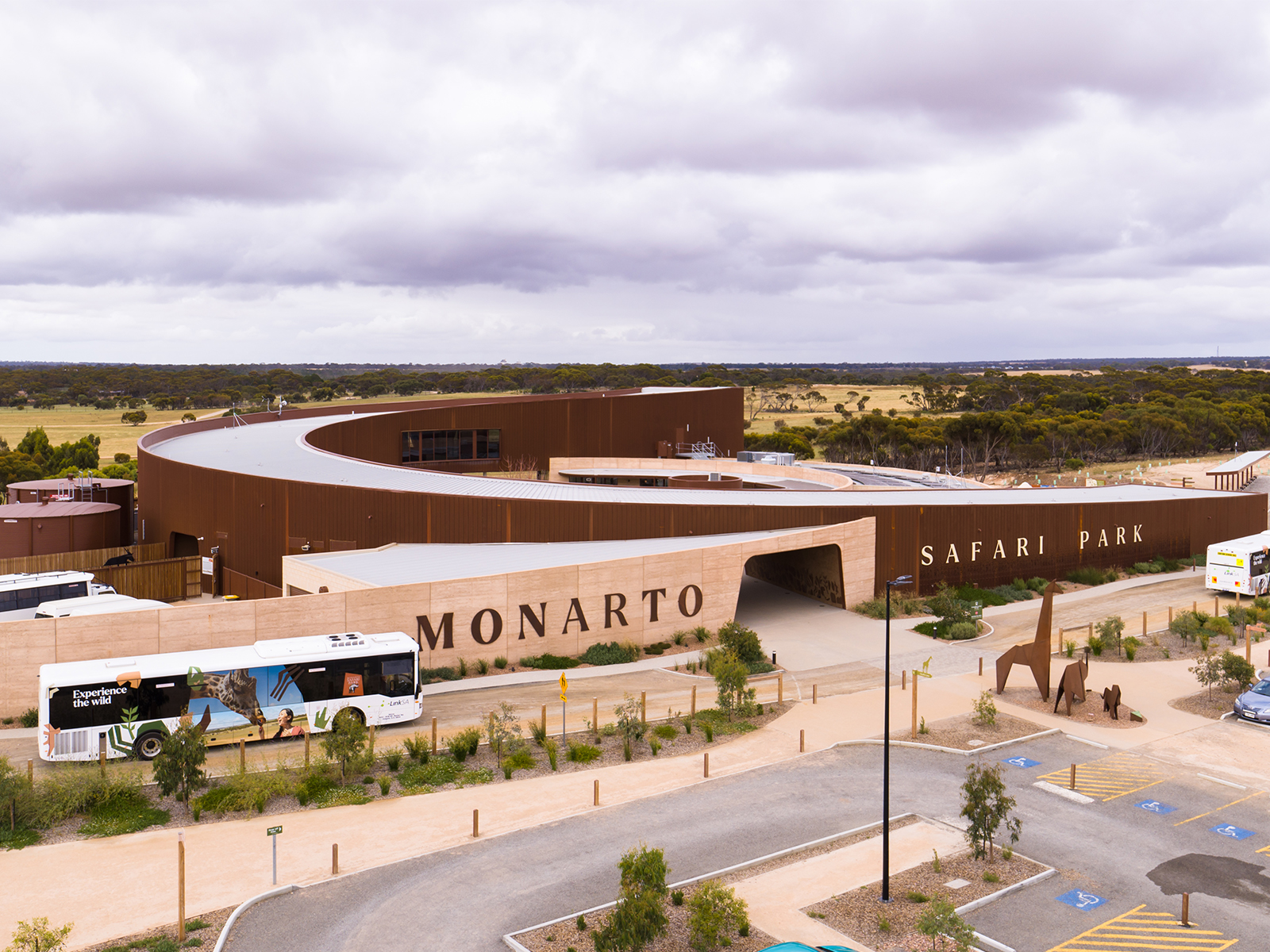 |
| Main Entrance (supplied) |
In its simplest form, Monarto makes an excellent family day trip. Visitors can explore the park using the hop-on, hop-off Zu-loop bus, disembarking at different precincts before boarding another service to continue their journey.
At selected locations, the visit can be enhanced with additional close-up encounters, such as mingling with the meerkats, feeding a giraffe or joining a guided walk through the Land of the Lemurs. These experiences cost extra and are best booked in advance, but they offer a more intimate perspective on the animals and the keepers' work.
Walking offers a slower, quieter alternative to staying on the bus. It provides more time to observe the landscape, watch native wildlife and approach the major habitats at your own pace. Most visitors will find that a combination works best: take the bus to a distant precinct, walk between several viewing areas and then rejoin the Zu-loop.

The guided journey is part wildlife encounter and part education. Our guide explained the animals’ behaviour, their natural habitats, and the conservation programs that help protect them. Beyond the headline attractions were species I might easily have overlooked on a conventional safari, including elegant eland, shaggy Barbary sheep, waterbuck and nyala. All moved through the landscape with an ease that reinforced the park’s impressive sense of scale.
Of course, this is not Kruger National Park or the Serengeti. There are no hours spent searching dusty tracks for a fleeting glimpse of a leopard, nor the thrill of unexpectedly encountering a herd of elephants in the wild. Yet Monarto delivers something remarkably atmospheric without the long-haul flight, complex logistics or substantial expense of an African journey. A family can leave Adelaide in the morning, spend the day on safari and still be home in time for a late dinner.
Staying overnight, however, completely changes the character of the visit.
My recommendation is to book a night either before or after a full day in the park. Since you have made the effort to stay, it is also worth adding one of the dawn or sunset safari experiences offered to overnight guests at a discounted rate.
The resort is likely to appeal to families and travellers who prefer conventional hotel comforts, including spacious rooms, dining facilities and a swimming pool. The Safari Lodge, by contrast, is more intimate and immersive, making it particularly attractive to couples or those celebrating a special occasion.
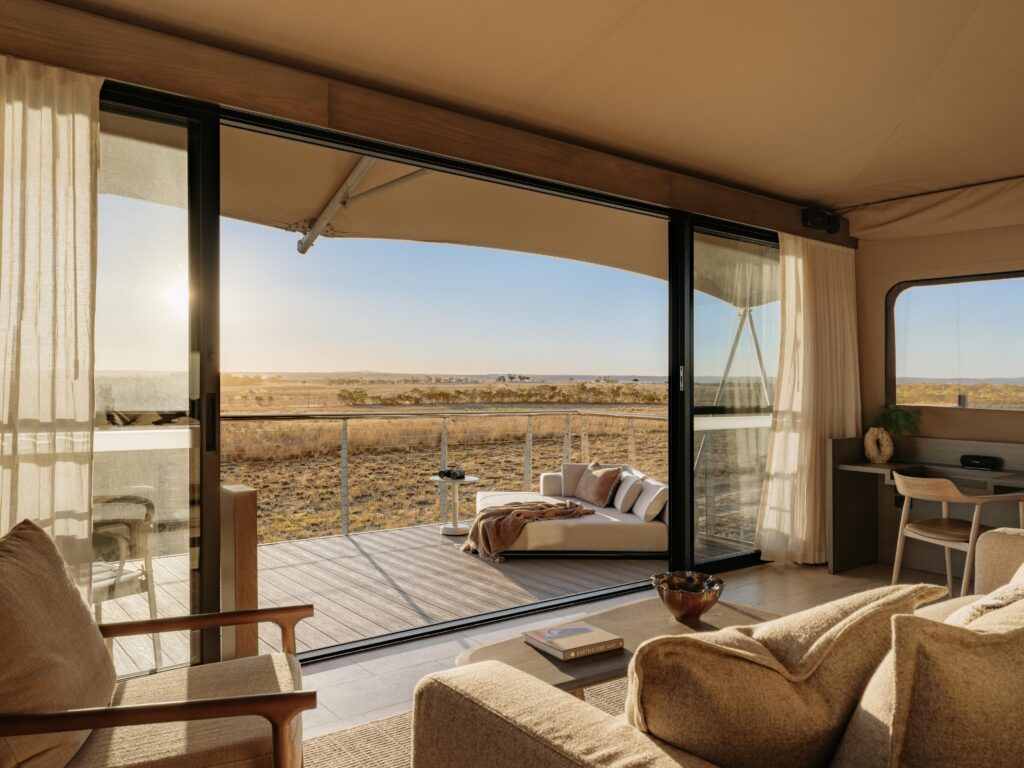 |
| Safari tent at The Lodge (supplied) |
Its luxury tented accommodation brings the atmosphere of an African safari camp to the South Australian bush. Canvas, timber and uninterrupted views create a sense of adventure, while comfortable beds, private bathrooms and thoughtful touches keep the experience firmly at the luxury end of glamping.
Once the day visitors have departed, Monarto becomes noticeably quieter. There is no traffic noise or urban glare, despite Adelaide being little more than an hour away. As evening settles over the plains, the light softens and the surrounding landscape takes on a more remote and contemplative character.
Waking within the park was the highlight. In the clear morning light, animals were already moving across the grasslands while the landscape slowly came to life. The sense of stillness made it easy to forget how close I was to the city.
Monarto may not replace an expedition to Africa, but it offers an impressive and accessible introduction to the safari experience. More importantly, it provides a rare opportunity to slow down, observe extraordinary animals and appreciate the conservation work required to ensure their survival.
For one night, at least, South Australia felt remarkably close to the African savannah.
HOW TO DO IT
Monarto can be experienced at several levels, ranging from a straightforward family day out to a fully hosted luxury safari stay. The important distinction is that Monarto Safari Park, Monarto Safari Resort and Safari Lodge are connected but separate operations, with different tickets, accommodation and touring options.
1. A general-admission day visit
This is the simplest and most economical way to see Monarto. Visitors park at the main Visitor Centre—private cars are not driven through the animal habitats—and explore using the complimentary Zu-loop bus included with admission. [Ticket Information]
The bus follows a circuit through the open-range precincts, with a guide providing commentary about the animals and conservation programs. A complete circuit takes about 90 minutes without stopping, but passengers can disembark at six viewing platforms, explore an area and then board a later bus. Services generally run every 15 to 30 minutes.
This option suits families, first-time visitors and anyone who wants a broad overview of the park. Monarto recommends allowing at least four or five hours rather than treating it as a quick zoo visit. Non-members currently need to pre-book a date-specific admission ticket.
2. Exploring on foot
Visitors can also explore Monarto through approximately 12 kilometres of walking tracks. The trails range from easy to medium difficulty and connect the Visitor Centre, bus stops and animal-viewing platforms.
Walking offers a slower and quieter experience than staying on the bus. You have more time to observe the landscape, watch native wildlife and approach the major habitats at your own pace. Most visitors will find that a combination works best: take the bus to a distant precinct, walk between several viewing areas and then rejoin the Zu-loop.
3. Keeper talks and animal feeds
Daily keeper presentations are included with general admission. Depending on the program, these may cover animals such as giraffes, chimpanzees, rhinoceroses, meerkats, cheetahs, Tasmanian devils and carnivores.
These sessions are worth planning around because animals are often more active during feeds or enrichment activities. They also provide context about behaviour, breeding and Monarto’s conservation work. Keeper talks are Auslan interpreted and audio described.
4. Bookable close-up animal experiences
For a more personal encounter, Monarto offers paid experiences in addition to general admission. Current options include:
- Lions 360, where visitors enter a protected viewing enclosure within the lion habitat.
- Giraffe Safari, including the opportunity to hand-feed a giraffe.
- Meet the Rhinos and the Black & White Rhino Interactive.
- Meerkat Mingle, with meerkats moving around participants in search of food.
- Cheetah Experience.
- Land of the Lemurs, a guided walk through the animals’ large habitat.
- Keeper for a Morning and Keeper for a Day, providing behind-the-scenes insight into animal care.

5. Staying at Monarto Safari Resort
The resort provides conventional hotel-style accommodation in rooms and suites, with restaurants, a swimming pool, spa facilities and views across the surrounding landscape.
Resort guests can purchase discounted general admission and add experiences available only to overnight guests. These include a two-hour Dawn Wildlife Safari before the park opens and a 2½-hour Sunset Wildlife Safari after normal visiting hours. Both use purpose-built safari trucks and enter the Wild Africa precinct in small groups, providing opportunities to photograph giraffes, rhinoceroses, zebras, cheetahs, eland, ostriches, oryx and hippopotamuses.
This is the best middle-ground option: the comfort and flexibility of a resort stay combined with an early-morning or evening safari.

6. A luxury tented stay at Safari Lodge
Safari Lodge is the most immersive and expensive option. It has 20 luxury safari tents overlooking a waterhole and the Wild Africa landscape. Tents have proper beds, ensuite bathrooms, lounge areas and private outdoor decks rather than basic camping facilities.
The minimum stay is currently two nights. Standard inclusions cover meals, selected beverages, a sunset safari and a multi-day Monarto Safari Park pass. Guests may see giraffes, zebras, eland, ostriches, nyala and oryx from the lodge area. An upgraded package adds another open-range safari in an open-sided LandCruiser, while a wellness package includes spa treatments.
7. Private and group visits
Schools, clubs, tour groups and corporate parties can organise private hosted tours, shared Zu-loop visits and selected twilight experiences. Function spaces include unusual settings such as the Lions 360 dome and giraffe-viewing areas. These arrangements normally need advance bookings and minimum group numbers.
For most first-time visitors, the best formula is one full day combining the Zu-loop, several walks, keeper talks and one booked animal encounter. Staying at the resort adds the atmospheric dawn or sunset component, while Safari Lodge turns the visit into a genuine two-night wildlife holiday.
All material (c) Copyright Traveloscopy.com unless noted otherwise.


No comments:
Post a Comment