google.com, pub-5161388013621688, DIRECT, f08c47fec0942fa0 Traveloscopy Travelblog Traveloscopy Travelblog

April 30, 2007

qualia: Unusual Luxury


Australia’s excited, Queensland’s excited and even the landscape gardeners on Hamilton Island are excited at the opening of Qualia, a luxury resort rivalling the best in the world. PAMELA WRIGHT reports onsite.

Although the Whitsunday Islands offer five star accommodation, there’s never been anything quite like the new resort, Qualia. The name has Latin origins meaning ‘a collection of sensory experiences’ and without doubt, lives up to its name. Set right on the secluded northern point of Hamilton Island in The Whitsundays, the exclusive resort consists of 60 private pavilions and is not just luxury, but luxury plus. About the size of a small house at 140 square metres, all villas have magnificent island vistas, dedicated staff, a private central swimming pool and exceptional, gourmet dining. About half of them have private plunge pools and I can imagine, after settling in, that plenty of guests won’t even contemplate leaving this special seclusion for the duration of their stay. I wouldn’t, although I might take leave of absence and head down to the main street of Hamilton to check out the different restaurants and bars which are lively and fun. And it’s not as if you’re stuck if you want to get out and about. Getting around is made easy with new-fangled electric two-person buggies, with one assigned to each pavilion. A bit like golf buggies, they’re easy to manoeuvre and they’re yours to use whenever you want.

Bob Oatley and son Sandy, who own the whole island, were responsible for the creation of qualia, an important addition to the premium extreme of Australian accommodation and they feel sure it will reinvigorate the luxury market here. “With uncompromising service and outstanding facilities, attention to detail in the design and construction and the scale and quality of the gardens, pools and public areas has never been seen before in this country,” said Sandy. And guests from overseas will appreciate that Qualia is distinctively Australian even down to the last piece of landscaping with the pavilions crafted from locally-sourced native timbers and stone, all set among eucalyptus trees and views of the Australian coastline and Whitsunday Passage. “The ground at Hamo is rocky and the land very hilly so the main aim was to make the mountain green and consumer friendly and we succeeded,” bragged one of the head landscape gardeners objectively. “qualia was a huge undertaking but it looks fantastic and the contrast from the land to the sea makes a magical setting,” added happy landscaper Carl Friend. Having stayed in many five star properties, this casually elegant resort has a new appeal that both domestic and international visitors have been waiting for. Built on 30 acres, the setting of the pavilions makes the most of the sun during the day and sunrises and sunsets to die for.

After landing at the Great Barrier Reef airport on daily flights from Sydney, Melbourne, Brisbane and Cairns, guests, who are restricted to 18 years and over, are transferred in sumptuous style to the Long Pavilion for check-in and welcome drinks in the very swish sunken lounge at the $75 million dollar development. Of course some will arrive by helicopter and others will moor their yachts at the 205 berth Hamilton Island marina. Next year, yachties will be able to use the new Great Barrier Reef Yacht Club and the following year, the Peter Thomson designed 18-hole championship golf course will be in full swing, just across the water on Dent Island.

‘Where else but Queensland’ especially when a tailor made helicopter or boat tour will take qualia guests to The Great Barrier Reef, the most extensive reef system in the world, with 1500 species of fish, a kaleidoscope of 400 types of coral and more than 30 different marine mammals. And just 25 minutes by boat is the famous Whitehaven Beach where the pure white silicon sand can be so bright on a sunny day, sunglasses are compulsory.

Spa Qualia, by the water’s edge with the sound of the sea to soothe, has four single treatment rooms and two couples rooms complete with Roman bath, a state of the art gym, two infinity pools and a pavilion tha can be used for yoga and meditation. There are two signature treatments, both from Australia. The first is a hot stone massage called Bularri Yarrul or “warm stone” in the Kamilaroi indigenous language using 300 million year old stones from northern New South Wales. Their energy “jiva” has a deep relaxing effect on the muscles and the synergy of the stones combined with the massage is very effective in relieving tension. The second treatment, a one hour aromatherapy massage, uses a boutique range of ten Australian handmade blended essential oils called Anoint which act on the body's energy centres, or chakras, to release emotional blocks and provide relaxation and grounding.

Keeping in mind that rates include all meals, non-alcoholic beverages, non-motorised water sports, exclusive use of an electric buggy and complete indulgence, a pavilion with a plunge pool will cost $A1600 per night and $A1400 without. The ultimate in luxury is the larger Beach House right on the water with extensive entertaining areas, a full size swimming pool and a separate guest pavilion at $3000 per night. And if you want a change in your dining routine, a few selected restaurants in the main street of Hamilton are on the menu.

The head chef at qualia, Frenchman Stephane Rio, was treated to a European food familiarisation before starting at the resort. To ensure that he was right up to date with the best international food, he was sent on a ‘study tour’ to catch up on the latest trends and collect innovative recipes to be served at the two main restaurants, the elegant Long Pavilion and the more casual Pebbles. Rio and his team provide exceptional food and wine with special dining options available on the beach, in the library, in private dining rooms or, you can even order a specially prepared gourmet picnic served on the beach.

All sorts of activities, 40 altogether, are available on Hamilton and I ventured forth to try the relatively new Jetryder, a high-speed, 420 horsepower speedboat. It takes up to 14 passengers on a 30 minute super fast ride and shows some of the surrounding islands although, with the spins and full-time hanging on, there’s little opportunity to find out which is which.

The choice of the name qualia was very important to the owners and is best summed up by the beautiful ocean breeze from the Coral Sea, the water lapping over the pebble shore, the rustling of gum leaves and the scent of eucalyptus trees combined with the taste sensations of world class chefs. With a tropical climate year round, from 23 degrees Celsius in winter to 31 in summer, any which way, qualia is all too much for the senses.

For more information visit www.qualiaresort.com.au or email qualia@hamiltonisland.com.au

March 31, 2007

Journeys


Journeys

Musings from the team of travel writers and photographers of the Global Travel Writers alliance.

February 05, 2007

Rediscovering Aotearoa

Rediscovering Aotearoa
Bay of Islands, North Island, New Zealand

New Zealand’s idyllic Bay of Islands is one of the world’s most attractive aquatic playgrounds.

Oceanic Discoverer moored off Roberton Island as seen from the lookoutHow do I know? Well, I’m just back from five nights aboard Coral Princess Cruises’s Oceanic Discoverer where she has completed her short season in the Northland region of New Zealand.

The narrow, labyrinth of waterways that stretch all the way from Auckland to Cape Reinga on the very tip of the North Island, are a stunning series of beautiful beaches, lush tropical islands and gorgeous bays and harbours.

Attractive; because the entire region is populated by leisure and pleasure boats of all sizes. Oceanic Discoverer, at 2000 tonnes and with room for just 76 passengers, was probably the largest vessel in the region at the time. Other vessels included multi-million dollar sports cruisers, international luxury mega yachts and giant ocean racing yachts. There were even two classic sailing vessels, the youngest being perhaps 100 years old.

Unlike her more rigorous expeditions in the Kimberley, PNG and Melanesia, this was a relaxed dawdle by comparison. All the same, she relished the crystal clear waters and tiny islands, many of which form valuable biological sanctuaries for New Zealand’s acutely endangered flora and fauna.

Our program of shore excursions included nature walks, cruising aboard the 80-seat tender, Xplorer, and visits to wildlife sanctuaries like Tiritiri.

Harbourmaster and pilot, Jim Lyle, was aboard for the trip, assisting Capt Scott Wilson through the tricky bits. “The number of vessels in the region dropped off markedly after 9/11, but it is pleasing to see a great many international ones returning. I’d say we’re pretty much recovered.”


Oceanic Discoverer visits New Zealand annually over New Year as part of her wider South Pacific program. See: www.coralprincess.com.au or phone 1800 079 545

July 31, 2006

Expediton ship review: Kapitan Khlebnikov


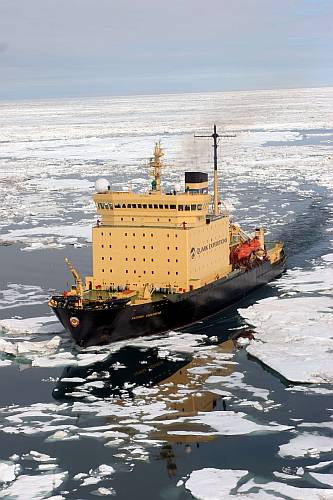
Voyage beyond Arctic ice into a land of legend aboard the world’s most famous passenger-carrying icebreaker, the Kapitan Khlebnikov. Words Roderick Eime.

The fabled Arctic silence is shattered by spine-chilling, rapid-fire cracks as the metre-thick sea ice disappears beneath the ravenous hull. With each hungry lunge forward, the I/B Kapitan Khlebnikov consumes another “mouthful” of pack ice, crushes it mercilessly under its considerable weight, then unceremoniously spits it out in tiny fragments, some chunks rocketing amid the debris tens of metres sideways out onto the flow. This dramatic description is not something you will read in most cruise brochures as they describe crystal white sandy beaches, palm-lined atolls and lavish nightly entertainment. The icebreaker, Kapitan Khlebnikov, is certainly the most celebrated passenger-carrying vessel of its type. It has circumnavigated Antarctica, probed the southernmost reaches of the oceans and made numerous crossings of the fabled North-West Passage.

She, if I may call the revered Kapitan a “she”, was constructed by Wartsila in Helsinki and launched on November 5, 1980. She immediately entered the Soviet Arctic fleet and still carries the hammer and sickle insignia prominently on her bow. Her initial duties were to escort convoys of cargo and naval vessels along Russia’s extensive Arctic coastline, keeping important sea lanes free of ice. When the Soviet Union collapsed in 1989, Russia found she had a small fleet of expensive, state-of-the-art icebreakers and ice-class vessels with nothing much to do. Enter expedition cruising.

The concept of small vessel expeditions to exclusive, ultra-exotic locations was already well established in 1990 by pioneers like Lars Eric Lindblad when North American charter company Quark Expeditions, and Sydney-based Adventure Associates seized on the idea of redeploying the ex-Soviet fleet for extreme passenger voyages. Since then, several vessels of varying capability have been refitted for passenger comfort, including the I/B Kapitan Khlebnikov, which made its debut passenger voyage in 1992.

My chosen itinerary was the Khlebnikov’s Arctic “season opener”, sailing north from Siberia through the Bering Strait into the ice-choked Chukchi Sea to Russia’s Wrangel Island. Located 500 kilometres north of the Arctic Circle, Wrangel Island is not the sort of destination you’d automatically be drawn to. UNESCO, however, recently added it to the World Heritage List because of the natural assets which include polar bears, walrus, Arctic fox, seals, snow geese and umpteen seabirds. Wrangel Island also escaped glaciation in the last Ice Age, leaving several unique species of vascular plants. It was also probably the last place on earth to support a woolly mammoth population. Although many of the bones and tusks have been removed, it is still possible to see some skeletal remains of these extinct giants scattered across the landscape.

The journey is as much a part of the adventure as the destination. While we’re ploughing through the barrier of stubborn sea ice that separates Wrangel from the Siberian mainland, it’s an opportune time to watch for polar bears as they hang out on the great frozen rafts in search of seals to devour. About 10 animals were spotted in total, half of them desperately cute, first-season cubs following on mother’s hindquarters as if attached by a string.

Access to the lofty bridge is normally available 24/7 to passengers wishing to get a firsthand account of a busy Russian icebreaker captain’s day on the job. The expansive bridge is chock-a-block with radar, depth sounders, an array of GPS equipment, radios, optical aids, engine controls and good ol’ fashioned charts the size of tablecloths.

Occasionally when the expanse of ice appears solid to the horizon, the captain will send out a helicopter in search of open leads in the pack that will ease our progress. These same helicopters, Russian MI-2s for the technically minded, are used to ferry passengers ashore for excursions where the rigid Zodiac inflatable boats are impractical. Case in point: our expedition leader, Jane Wilson, heard that traditional reindeer herders were near Cape Dezhynov at the very eastern tip of the continent. An MI-2 was dispatched to locate them and contact was made. Armed with gifts of sugar, flour, fresh vegetables and powdered milk, we returned by MI-2 to spend an enthralling afternoon in their company as they led nearly 2000 beasts across the tundra and through glorious valleys some five kilometres inland.

A typical day aboard the Khlebnikov usually involves a shore excursion, either by helicopter or Zodiac, after breakfast and lunch. But the generous Arctic summer allows almost constant sunlight, so activities can take place almost around the clock. One glorious sun-drenched afternoon, the ship suddenly halted amid the vast ice pack accompanied by the announcement: “Today we have a barbeque lunch on the forward deck!”

Then, in a flurry of activity, deck hands piled up the Zodiacs, broke out the trestle tables, craned an enormous charcoal BBQ from the hold and proceeded to lay on the most sumptuous grill laden with steak, wurst of all varieties, chicken, fish and salads. It was all lubricated with ladles of fragrant gluhwein. On days when the vessel is at sea, there are expert lecturers giving enthralling lectures on the history, wildlife and ethnography of the region. One ebullient example, Bob Headland, takes leave from his post at the Scott Polar Research Institute to enrich passengers with his almost limitless knowledge of things polar. Buy him a drink, as I discovered, and your enrichment is likely to continue well into the wee hours.

These extreme adventure cruises are certainly not for everybody. If you are a committed devotee of the traditional mega-vessels with Las Vegas-style entertainment, shopping malls, casinos and all-you-can-eat buffets, then the Kapitan Khlebnikov is not for you. Cabins are comfortable and all have private facilities, but despite many added creature comforts, the Khlebnikov is still a working vessel built tough for the travails of the unforgiving Arctic winters. Having said that, Hotel Manager Karl Heinz Iborg brings with him years of land-based hotel experience and ensures comfort levels are well within tolerance for expeditioners not inclined to the Spartan rigours of the Russian Arctic. Executive chef Olaf Roos serves three generous meals per day, typically with meat/fish/vegetable main course alternatives available for lunch and dinner. A full, hotel-style hot breakfast is available each morning replete with bacon, eggs, cheeses, breads, cereals, jams and an array of fruit more akin to a tropical island leisure cruise. No one goes hungry on the Khlebnikov!

When it’s time for a nightcap, the bar is open as late as you want it to be. In the high Arctic summer, the sun never sets, so be careful because before you know it, it’s 3.00 am and the champagne’s still flowing! The Khlebnikov’s bar is more an intimate tavern style establishment than a rowdy nightclub. It’s a great place to get to know your fellow explorers and swap tall tales of the day’s adventures.

Sailing aboard an icebreaker is a very different experience from any you may recall from your P&O or Cunard cruise. An icebreaker, by necessity, is a shallow-draught vessel devoid of protruding stabilisers and its rounded hull below the water line protects it from ship-crushing lateral ice pressure.

Fortunately for me, the northern polar waters are usually mill-pond calm compared to the capricious Southern Ocean where Khlebnikov will travel in the southern summer en route to such destinations as the Ross Sea and McMurdo Sound. As a result, an icebreaker, with its low centre of gravity, will roll significantly in heavy seas, testing the mettle of any sailor. If you’re yearning for an icebreaker experience, and I heartily commend it, but you’re prone to seasickness, then look at the Arctic itineraries where seas are milder. Any polar itinerary is always weather-and ice-dependent. It’s both an advantage and disadvantage and quickly shows the experience and expertise of the expedition leader. As one port or destination is discounted, another may become accessible, adding to the adventure. Wildlife is exactly that and may (or may not) appear as expected in any given location, especially nomadic animals like polar bears, whales and some seals like the elusive leopard seal of Antarctica. Notwithstanding this caveat, encounters with these rarer creatures take place on almost every voyage, adding a distinctly enviable cache to your trip.

Support Traveloscopy - Support Responsible Travel.

Traveloscopy is a freelance journalism enterprise supporting the tourism and travel industries. We aim to encourage people to travel thoughtfully and responsibly and also support sustainable initiatives within the travel sector. You can help us cover our operating costs, even if in just a small way.

Last 30 Days' Most Popular Posts