google.com, pub-5161388013621688, DIRECT, f08c47fec0942fa0 Traveloscopy Travelblog Traveloscopy Travelblog

February 24, 2016

Struth! Robert Louis Stevenson's birthday gift

IN his continuing search for the more weird and wondrous in this world, David Ellis wonders if anyone has ever given a gift so unique as that bestowed by Scottish author Robert Louis Stevenson upon a 12-year-old American girl in Samoa in 1891.

For his gift to her was his birthday.

In the hope of improving his poor health Stevenson, his wife Fannie Osbourne and her son Lloyd from a previous marriage had gone to Samoa after living in Sydney for a short time, and there met America's local Land Commissioner, Mr Henry C. Ide – who confided how sad his daughter Annie was that she had never had a real birthday because she had been born on Christmas Day.

So Stevenson penned her a letter commiserating as to how she had been "denied the consolation and profit of a Proper Birthday," and added this deed:

I do hereby transfer to A.H. Ide, All and Whole of my rights and privileges in the 13th day of November, formerly my birthday, now, hereby, and henceforth, the birthday of the said A. H. Ide, to have, hold, exercise and enjoy the same in the customary manner, by the sporting of fine raiment, eating of rich meats and receipt of gifts, compliments and copies of verse, according to the manner of our ancestors.

… and I charge her to use my said birthday with moderation and humanity, the said birthday not being so young as it once was and having carried me in a very satisfactory manner since I can remember.

I hereto set my hand and seal this 19th day of June in the year of grace eighteen hundred and ninety-one.

- Robert Louis Stevenson.


Struth! Hotel lost and found reveals bizarre finds


IN his continuing search for the more weird, wacky and wondrous in this world, David Ellis says a recent meeting of hoteliers in England decided they'd need a book the size of a metropolitan telephone directory to list the bizarre range of items guests had left in their hotel's rooms.

For in just 12 months they included an urn with the ashes of one man's mother-in-law, a blow-up, anatomically well-endowed sheep, a live 2-metre snake in a parrot cage, and such bodily accessories as staring glass eyes, false arms and legs, hearing aids, and countless sets of false teeth soaking in everything from glasses of wine to, in one case, the hotel's toilet disinfectant.

A live rabbit with a leather collar and walking-lead around its neck was found cowering in one room, a pet tarantula spider in a round glass fish tank in another, and in one hotel's garage an overlooked thoroughbred race-horse was found tied up after a local race meeting that had been held three days before.

And after a week one sheepish guest returned to a country town's budget hotel that was popular with prostitutes, to claim his forgotten car keys – for a $325,000 Porsche.

Staff also found a 2-metre working model of a helicopter left in one pub room, a police car siren connected to a 12V battery in another… and a life-size dummy of comedian, actor and TV presenter, Sir Lenny Henry in yet another.

Hoteliers said they couldn't even begin to estimate the number of sex toys left after one-night stands, and all agreed that the most-often left items were phone chargers… last year in just one major chain alone 42,000 were left plugged into power points by forgetful guests.

Jane Bednall, from Holiday Inn, said: "It's quite unbelievable just how much is left behind by our guests each year. The phone chargers would easily stretch across the English Channel.

"Most items are not re-claimed and after six months we donate anything of value to local charities."


[] PHONE chargers are the most-often left items in English hotel rooms, an amazing 42,000 of them last year in just one major hotel chain alone.


February 08, 2016

Struth! Notting Hill movie park bench secret


MOVIE'S PARK BENCH A PERTH TREASURE

IN his continuing search for the more weird, wacky and wondrous in this world, David Ellis says there's a park bench in Perth's Queens Gardens that looks like it could be any old-style bench in any gardens in any part of the world.

But this one has fame on its side, if not many visitors are actually aware, for a history that's both equally famous and sad.

Famous because it was the park bench on which Julia Roberts and Hugh Grant talked love in the 1999 romantic comedy Notting Hill.

THE park bench from the 1999 romantic comedy, Notting Hill –
 now a "treasure" for Perth's Queens Gardens with its history that's
 both richly famous and sad. (ParksPhotography)
And sad because a Perth man subsequently bought the bench after the film had creamed the box office, and gave it as a birthday gift to his girlfriend – and one day when they sat on it, proposed to her.

Unfortunately for him his plea was rebuffed, the relationship ended… and he finished up with the bench, which he decided to give to the Gardens, so that with its history it could be enjoyed by others.

Now considered something of a Gardens "treasure" it still has the words carved onto it from the film: "For June who loved this garden, from Joseph who always sat beside her."

The donor insisted that despite the value of his gift to the Gardens his identity always remain secret, the only clue to he and the lady who rejected his hand in marriage being "Rodd & Nicole 2002," etched behind the bench's top rail.

February 01, 2016

Struth! World's scariest airport

WHEN their Dutch administrators told them that an airstrip on their tiny Caribbean Island of Saba was "an impossibility," the locals took-to and hand-built this one themselves. (Wikipedia)
IN his continuing search for the more weird, wacky and wondrous in this world, David Ellis says that those who have done it say that landing by plane on the tiny Netherlands Antilles island of Saba in the Caribbean is the most-hair-raising you'll encounter anywhere, somewhat akin they'll tell you, to landing on an aircraft carrier.

Because at just under 400 metres the airstrip is the shortest commercial landing field in the world, it's got steep cliffs dropping immediately into the sea at both ends, an equally deep and sheer drop close to one side, and a towering mountain near to the other side.


And then there's the wind…

And bizarrely when the Dutch government said it couldn't build them an airstrip the 1,850 Sabans decided to do the job themselves, hand clearing the only level spot on the tiny 13sq km blob (5sq miles) – just as they'd hand-built their own road around the island when Dutch engineers told them a road through that mountainous terrain was "an impossibility" too.

Just one aircraft flies the 12-minute route from neighbouring St Maarten Island several times a day, Winair's little 16-seat Twin Otter whose pilots agree that landing and coming to an abrupt stop on Saba so as not to run off the other end, is "something of an art form."

January 28, 2016

Struth! Worlds biggest pumpkin pie feeds 4000


Pumpkin Pie Big Enough To Feed 4,000

IN his continuing search for the more weird and wondrous in this world, David Ellis says that when the good folks of New Bremen in Ohio were looking for something special as a centrepiece for their annual PumpkinFest back in 2010, they thought what better than an oversize pumpkin pie that would really get tongues wagging.

And wag they did, for that pumpkin pie is still recognised five years later by the Guinness Book of Records as being the Biggest Pumpkin Pie Ever Made, and a fitting tribute in this little farming town that's a major supplier of pumpkins for the American market, and has developed novelty Giant Pumpkins that can weigh as much as 900kg (nearly 2000 pounds.)

For their 2010 record-breaking pumpkin pie, New Bremen's Giant Pumpkin Growers covered an enormous, "pie tray" that was custom-built for the occasion with 440 sheets of pie-crust dough, and for the actual filling had nine volunteer chefs whip together 550kg of mashed pumpkin, 2,796 eggs, 413 litres of evaporated milk, 238kg of sugar, 3.2kg of salt, and 6.5kg of cinnamon.

Then at midnight on the eve of their 2-day PumpkinFest they popped their now-1,678kg pie (that's 3,699 pounds, or 1.7 tonnes) into a specially made oven, cooked it for five hours, let it stand and cool for a further two – and finally after cutting a massive wedge out to display during their Festival, divided the remainder into over 4000 slices for an appreciative crowd of 'Fest-goers.


PHOTO CAPTION:


[] NINE volunteer chefs put together this 1,678kg (1.7 tonnes) Pumpkin Pie at the annual PumpkinFest in the little Ohio township of New Bremen.

(Photo: Greg Reynolds, New Bremen Giant Pumpkin Growers Assoc.)


Kava ceremonies in Fiji - a Melanesian tradition

KAVA AND CUSTOM – A FIJI HOMECOMING

David Ellis
with
David Potts

THE remote islands of Fiji's Lau group seemingly lie at the edge of the world, huddled crescent-shaped to the east of the main islands of that country and about halfway between there and Tonga.

So remote are they that these are places with no postcards, and just a third of their 100 volcanic dots are even inhabited.

Its this isolation that's prompted Captain Cook Cruises to add an 11-day Lau islands itinerary aboard it's Reef Endeavour to three-, four-, and seven-day cruises around Fiji's other captivating islands.

And interestingly around 70 per cent of Reef Endeavour's maximum 130 passengers on a recent early sailing to the Lau group were loyal former guests.

An ocean of coral reefs makes navigating the islands a challenge, but captain and crew bring the vessel within reach, by tender, of sandy, palm-fringed beaches lapped by warm tropical waters a spectacular 50 shades of blue.

Abundant coral and the great variety of fish make for ideal diving and snorkelling, and a Tongan influence is evident in the unique language, food, architecture and religion of these islands – and their most popular sport, cricket.

Life here is simple and all about family and community, smiles and laughter, with villagers living mostly on what they can grow or can harvest from the sea. Any meagre income comes from copra from small coconut plantations and fishing.

And for these happy souls, a bowl of kava, a wooden log – or a cardboard box – and a couple of drumming sticks make for an instant party.

Passengers from Reef Endeavour are greeted warmly, although the children keep their distance, watching-on shyly. Finally a traditional welcome follows at which gifts are given by passengers of yagona plants from which is made the social and ceremonial drink, kava, widely enjoyed in the Pacific islands.

There are speeches too, and a meke, or song and dance performance, and perhaps a lovo, a meal cooked underground, Fijian-Tongan style will follow.

Wailagilala Island that Reef Endeavour visits is Fiji's only true coral cay. Everybody's idea of a tropical island, this tiny atoll rises no more than three metres above the sea. Palm trees lean over the sand to hang above the green and blue water. On golden sand, visitors enjoy a solitude broken only by the cries of the seabirds that nest here.

Horseshoe-shaped Vanuabalavu, or Bay of Islands, offers 15 amazing limestone islets with caves to snorkel and explore.
Then it's on to Oneata Island at the eastern edge of the Lau group. It is Sunday and the village church is packed for the morning service, the villagers in their Sunday best of white for the women and black sulus and clean business shirts for the men. They 'raise the roof' with booming, unaccompanied hymn-singing, many visitors from the ship saying attendance at a church service always a highlight of their visit to Fiji.

The Fulaga Islands are next, a string of 100 islands and limestone rocks that enclose a lagoon, the islands themselves appearing to grow out of the lagoon into incredible mushroom shapes.

On Vuaqava island local stalls have been set up selling coconut crabs the size of footballs, some of which will finish up tonight in the ship's galley.

Then its onto Kabara Island with its four villages and a total population of around 500. The Tongan influence is reflected here in language and dance, villagers performing song and dance for their visitors who present them with traditional gifts of cloth – and there's more kava, of course.

Cricket is popular here and passengers have brought gifts including a cricket set and footballs.

Then finally it's the island of Kadavu. This is almost civilisation – it has an airstrip. A ritual turtle-calling ceremony is promised, but the turtles, the visitors are told, are sleeping and there are none today.

Perhaps they're simply as laidback as the Lau islanders themselves.

(Writer David Potts was a guest of Captain Cook Cruises.)


GETTING THERE: Captain Cook Cruises operates a three-night Yasawa Islands cruise from Port Denarau, Fiji, from AUD$996 ppts; four-night cruise of the Yasawa Islands from AUD$1,356 ppts; seven-night Northern Fiji Discovery and Culture cruises from AUD$2,132 ppts; and the next 11-night Lau group and Kadavu cruise departs on March 1from AUD$4,635 ppts. More details www.captaincookcruisesfiji.com


…………………………..


PHOTO CAPTIONS:


[] CAPTAIN COOK CRUISES' Reef Endeavour now sails even further afield in Fiji with new voyages to the remote Lau Islands in the nation's far east.

[] SNORKELLING and exploring the caves on Vanuabalavu Island in the Lau group.

[] VILLAGERS welcome Reef Endeavour passengers with song and dance to their Kabara Island.

[] THE strange mushroom-shaped limestone islets in the lagoon on Fulaga Island.

[] A CREW member of Captain Cook Cruises' Reef Endeavour is given a traditional "Welcome Home" when the cruise ship visits Kabara Island in Fiji's Lau group where he was born.


(All images: David Potts)


January 26, 2016

WWII tanks in the Aussie bush

The rusting regiment of Murrayville

Roderick Eime

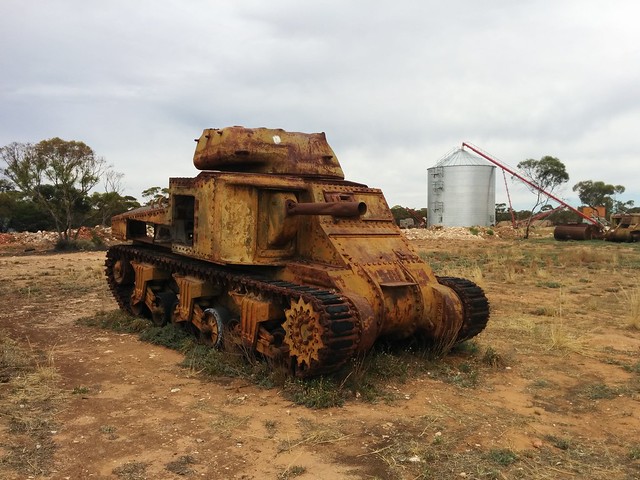
WWII tanks in scrapyard, Murrayville VIC

Driving along the Mallee Highway through rural Victoria back in 1982, I first discovered the Murrayville tank graveyard by accident when pulling over for a comfort stop.

Murrayville is a sleepy, century-old wheat farming village built on a railway line between Pinnaroo (SA) and Ouyen (Vic).

Imagine my surprise when laid out in front of me were the rusting remains of what seemed like an entire armoured regiment. Among the piles of scrap metal, discarded farm machinery, old cars and trucks were several easily discernable WWII-era tanks.

IMG_20151231_145020
January 2016. With much of the lighter scraps cleared, this old M3 stands alone. The turret has been replaced recently.

I counted at least six tanks; a couple of Matildas, another couple of Grants and another I like to believe was a Sherman. Most were in a sorry state with great chunks cut out of their hulls, turrets cast aside, engines and mechanicals stripped and tracks piled up under the trees.

Just what the heck were these forlorn armoured vehicles doing out here in the bush, thousands of miles from the nearest battlefield or even army base?

Blitz truck and WW2 tank
As seen in January 2012. Much of this scattered debris has been removed (Daniel Prowse)

The earliest forms of the Internet were still a decade away, so I wrote to the Australian War Memorial who, to my surprise and pleasure, wrote back.

They informed me an enterprising local engineer had bought the surplus vehicles after the war in order to convert them for earthmoving and agricultural duties. A kind of ‘swords to ploughshares’ effort. At the time, none of the vehicles presented restoration prospects or even a source of spare parts. Complete units, the AWM informed me, were still available on the market for those who wanted one.

How it looked before the site was "cleaned up"

I have made the drive through Murrayville countless times since and always made a point of popping by the old scrapyard to see what was happening to the tanks. Several years ago, most of the lighter metal scraps were removed and some of the hulls were bulldozed to make room for new buildings. At some point, someone had managed to roughly replace a turret on a sort-of complete Lee/Grant hull, shoving a length of drainpipe into the hole where the main gun once protruded.

In this rapidly changing world, it's no surprise to learn that some of these remote townships struggle to stay viable. Passenger services on the railway have long since stopped and retail businesses struggle to keep their doors open.

"We've often wanted to do something to make a feature in the town," Murrayville Museum & Heritage Society president, John Heintze told me over the phone, "but it's a constant struggle with bureaucracy to get anything done. After years of wrangling, we finally managed to get access to the old courthouse to expand the museum and we want to do something with the scout hall which is falling down, but we can't get permission for that. Red tape is our enemy here."

I’ve also learned, thanks to the Internet, that the chap responsible for this was a much respected local called Peter Peers who passed away in 2010 at the ripe old age of 99. It was believed that the vehicles were sourced from Darwin and driven (somehow) on a six-week journey to Murrayville* but it seems more likely that they were sourced from a stockpile in Albury, possibly that of Alf Baker, who would go on to open a car dealership. One wonders if these tanks served with our troops in either PNG or Borneo as they were already long-in-the-tooth models at war’s end. What tales could they tell?

The original museum building in Murrayville (denisbin)
Editor's note: I hope to expand on this story as new material comes to light, so please check back occasionally. If you have information to add, please leave a comment.

* please see comment below for correction. (thank you)

More Information:

Murrayville Community Website www.murrayville.com.au (site down)

ABC Central West: WWII tanks still used on farms

If you ever stop by the little town, pop into the museum and say 'hi' to curator, John Heintze.

January 25, 2016

Struth! Like watching grass trees grow

IN the wild, Australian grass trees in their natural state
at Sydney’s North Head Sanctuary. (GardenDrum.com)

If you’ve admired them growing majestically in the wild and are among increasing numbers of home-gardeners adopting the uniquely Australian grass tree (Xanthorrhoea) David Ellis says you’ll need plenty of patience if you want to track their growth.,

Because they add a mere 1-to-2.5 centimetres (that’s just under an inch) a year to their trunk height – meaning as one of the slowest growing plants in the world, they can take between 200 and 600 years to reach full size of five metres or so.

And in fact many fully-grown specimens that plant nurseries are now selling have come off land being cleared for farming, and are so old they could quite possibly have taken root hundreds of years before white man ever set foot in this country.

Aboriginal people long made clever use of different parts of the plant for food, drink, fibre, for making weapons, and even a super-glue, and yet without ever killing it.


AND cleverly used in a suburban front garden. (Cambridge Council, WA)

Now also being propogated by specialist nurseries from seed that can take up to a year to germinate, grass trees can cost from $50 for the tiniest fit-in-your-palm specimens, to $1000-plus for those more fully-grown.

And they can take up to three years to decide whether they’ll live or die in the garden spot you’ve chosen for them – if they live, eventually throwing 1- to 3-metre long cylindrical spikes smothered annually with little white to yellow florets loved by insects and birds.

Support Traveloscopy - Support Responsible Travel.

Traveloscopy is a freelance journalism enterprise supporting the tourism and travel industries. We aim to encourage people to travel thoughtfully and responsibly and also support sustainable initiatives within the travel sector. You can help us cover our operating costs, even if in just a small way.

Last 30 Days' Most Popular Posts