Served by traveloscopy.com

July 26, 2010

STRUTH - Best Pub in The Street

STRUTH !    

IN his continuing search for the more weird, wacky and wondrous in the world of travel, David Ellis says there's a street in Scotland far north that's just 2.06m long (6ft 9ins) and has just one address on it – a bistro in the local pub.

Ebenezer Place at Wick in Caithness County, was created in 1883 when Alexander Sinclair built a hotel at the corner of Union and River Streets. As the local council required him to identify his hotel on all faces, Mr Sinclair had "Mackays Hotel" painted on its Union and River Street sides, but "Ebenezer Place" at the top of the short and blunt end where the other two sides met.

But as that "corner" did not have a door in it, Mr Sinclair had to install one – and as soon as he did so, the Council then recognised the "corner end" of the hotel as an official address because it gave access to Mackays Hotel, and thus Ebenezer Place – all 2.06m of it – was declared an official street and an official mail delivery address.

Today Mackays Hotel still occupies the corner, with the one and only address on Ebenezer Place the No 1 Bistro within the hotel.

And interestingly, as well as laying claim to being the world's shortest street, Ebenezer Place has another interesting bit of history to it: Robert Louis Stevenson spent some of his childhood in Wick while his father built a breakwater in the local bay.

Stevenson Jnr later made reference to Ebenezer Place at "the five hand way" (Union Street, River Street, Bridge Street, Station Road and The Cliff that all joined at Ebenezer Place) in his novel Treasure Island.

July 24, 2010

BALI HAI IS CALLING – COME TO ME, COME TO ME…

David Ellis

Chances are you've never heard of Ambae Island or Makana Mountain. And having agreed on that, you're probably not really interested in reading any further.

But hang on, you've doubtless heard of, and maybe even read the book Tales of the South Pacific, or at least seen the movie. So you would know of the mysteriously rumbling and beautiful Bali Hai that kept rearing its volcanic peak throughout that movie.

And therein lies today's tale. For despite the fact they're thousands of kilometres apart, with one in the Southern and the other in the Northern Hemisphere, Ambae and Makana are virtually one, as inextricably linked as the divergent yarns that American author James A. Michener cobbled together for his classic volume Tales of the South Pacific in the 1940s.

Ambae dozes in the sun off the island of Santo in northern Vanuatu, and Makana stands majestically on the northern-most of the Hawaiian islands, Kauai.

But with its bag of tricks, Hollywood made them the-one when it came to making the movie South Pacific.

James A. Michener went to Vanuatu, then known as the New Hebrides, as an Intelligence Officer with the US Navy during the Pacific War, and later switched over to working as a Supply Officer. It was this latter role that enabled him to move around the islands, meeting the many characters whom he later melded into Tales of the South Pacific when he returned to New York and civilian life as a book editor at war's end.

Santo was a major America supply base in the war effort, and it was to off-shore Ambae that the local expatriate planters sought safety for their families.

Not that their concerns were about the war. Rather, they locked up their wives and daughters on Ambae because it was Out-of-Bounds to the thousands of women-less troops stationed on Santo.

Ambae had a high central peak that actually contained a lake, which in turn contained a volcanic crater. The mountain dominated the island and fascinated Michener, who referred to it as Vanicoro in his book, but when they made the stage show South Pacific, it was renamed Bali Hai.

And when it came to the follow-on movie, Hollywood just wasn't interested in going all the way to the far-flung and presumably-godforsaken New Hebrides to shoot scenes of pretty beaches, dense jungles and a rumbling volcano – even if Michener had written his book there.

Instead Hollywood chose the closer Kauai in Hawaii, and kept the name Bali Hai for the ever-rumbling mountain, while for the beach scenes the producers chose Kauai's Lumahai and Polihale Beaches, and for the jetty where the nurses and supplies kept coming ashore, took over a trade-ship jetty in the island's Hanalei Bay

Finally for the garden scenes around the oddly octagonal-shaped home of the French planter, Emille de Beche it used the Allerton Botanical Gardens that were once home in royal times to Hawaii's Queen Emma.
 
(The unique de Beche home on Santo really was octagonally-shaped and was recreated in a Hollywood studio, while Bloody Mary's trade-store-cum-home did exist as it appeared in the movie, and today still stands forlorn and empty under a great rain tree.)

But when it came to finding a nice volcanic peak next to a beach on Kauai for their Bali Hai, even Hollywood was stumped.  So their cameramen went inland to Makana Mountain in the Limahuli National Tropical Botanical Gardens – and to hide the fact it wasn't a stand-alone volcano behind the beach, had artists superimpose a wreath of cloud around its foothills in every frame of the master footage.

You can join a fascinating tour of the major movie sites on Kauai – a staggering 80-plus movies and TV series have been shot there, and they're still at it – or simply get a car, pick up a Film Location Map and do it yourself, but you won't learn as much as you do from the film-tour operators.

And while you're there, don't miss Limahuli Botanical Gardens' unique Hawaiian native plants, archaeological sites, and the engrossing tales and legends you'll hear from the guides.

And of course get pics of yourself in front of Bali Hai – but remember the locals still call it Makana and not Bali Hai.

And they say they're enormously proud of that.


PHOTO CAPTIONS:  

[] BALI HAI is calling – Kauai's Makana Mountain became Bali Hai in Hollywood's South Pacific.

[] THE real Bali Hai: Vanuatu's Ambae Island off the island of Santo

[] BLOODY Mary's tradestore still stands abandoned and forlorn on Santo Island

[] JAMES A Michener returned to Vanuatu in 1992.                                 


Cliveden House: WEEKEND OF SEX, SPIES, LIES AND DOWNFALLS


THE Astor's sprawling Cliveden House on 150ha on the banks of the River Thames.
David Ellis

FORTY NINE years ago this month British socialites, the 2nd Viscount and Lady Astor invited some friends to their stately Cliveden House on the banks of the Thames just outside London, for a summer's weekend of partying, tennis, croquet, boating on the river, and generally having a good time.

Little would they realise that their weekend would take on dimensions greater than anyone could have imaged: it resulted in one of Britain's greatest sex scandals, a spy expose, a suicide, the downfall of one of the country's most senior Cabinet Ministers – and ultimately the fall of the government itself.

Cliveden House has seldom been out of the public eye since the first "house" was built on its 150ha (375 acres) in 1666 by the 2nd Duke of Buckingham as an escape-hole with his mistress, burned down in 1795, and its replacement destroyed by fire in 1849.

To the horror of many, including "an astonished" Queen Victoria, the now-third Cliveden House was bought in 1893 by America's wealthiest man – William Waldorf Astor, who confounded British society even more by becoming a naturalised British subject, and going on to also purchase Hever Castle that brought with it the title Viscount Astor.

Astor's wife died prematurely and in 1906 he gave Cliveden to his son, Waldorf as a wedding gift, and moved himself into Hever Castle.

The newly-weds lost no time in inviting political leaders, writers, film stars, artists and other celebrities to lavish weekends at Cliveden House, amongst them Charlie Chaplin, Mahatma Gandhi, F.D. Roosevelt, Winston Churchill, Harold Macmillan, Joseph Kennedy, T.E. Lawrence, Rudyard Kipling and aviatrix Amy Johnson.

The Astor's were generous to a fault, and in WWI built a hospital in their grounds for the Canadian Red Cross; this was dismantled at war's end, and when WWII erupted the Astor's again offered the site for another hospital

And in 1942 they donated the entire property to the British National Trust, with the proviso they could live there for as long as they wished – giving the Trust 250,000 English pounds (around AU$15.2-million today) for its perpetual upkeep.

It was in 1961 the Astor's included amongst guests Britain's then Minister of War, John Profumo and his glamorous actress wife Valerie Hobson, Lord Mountbatten of Burma, and the President of Pakistan to a summer party on the weekend of July 8th at Cliveden.

Also invited to stay in the property's separate Spring Cottage was a London society osteopath, Stephen Ward who took with him several friends including 19-year old fun-loving, Christine Keeler and a Russian Assistant Naval Attache, Captain Yevgeny Ivanov.


FUN-time Christine Keeler at the time
of her illicit relationship with Britain's
then-Minister of War, the married
John Profumo.
At one stage of the balmy July evening, Profumo and others wandered down to the swimming pool to investigate sounds of much gaiety, and it was here he set eyes for the first time on Christine Keeler; within days they were lovers.

It lasted only several months before Profumo ended the relationship, but a question was raised in parliament by an Opposition member; Profumo categorically denied any improper relationship – and was floored when Keeler sold "their" story to a London newspaper.

Worse, she revealed she had been sleeping at the same time with the Russian Naval Attache, Ivanov – who, even worse-still it emerged, was a Soviet spy.

Profumo confessed to the House of Commons he had lied, and resigned.

The British government, hell-bent to distance itself from the scandal, bizarrely charged the osteopath Stephen Ward (who'd introduced Profumo and Keeler at Cliveden House,) with living off immoral earnings from Keeler's other relationships; Ward committed suicide before his case ended.

SPRING COTTAGE in the grounds of Cliveden House
– in which Christine Keeler stayed during
that ill-fated weekend in July 1961.
The current operators of Cliveden House, von Essen hotels have put together an intriguing Profumo Affair package there on the night of July 30: a mere 497.50pp British Pounds (AU$880pp) gets twin-share, a "Scandal Tour" walk around the property with long-time "Affair" researcher and expert Rupert Gavin, a Champagne and canapé reception, and a further "inside" talk over a 3-course dinner with wine by Rupert Gavin as to what secrets of The Profumo Affair his research suggests the government is still so determined to hide.

Next morning there's full English breakfast and use of the property's indoor and outdoor pools, tennis and squash courts, gym and hot tubs.

If you'd like a stay at Cliveden House, now a stately home hotel, visit www.clivedenhouse.co.uk

July 22, 2010

Wierd Travel Experience of the Week: Trash Talk

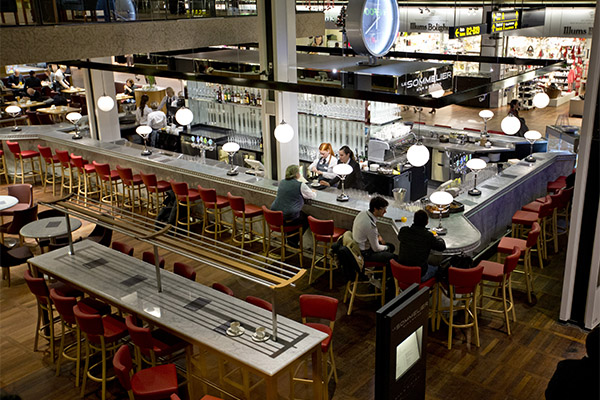
Sitting peacefully eating a sandwich at Copenhagen Airport this week. The food court area was busy and, like anywhere else in the world, some travellers had left their tables hurriedly, leaving scraps and unfinished meals. I squeezed onto the end of one such table, now vacant except for food and container debris.

Young man with cleaning trolley approaches table. Without resorting to remarks or generalisations, he was obviously not of Scandinavian extraction. Thinking I could assist him, I passed over some of the items cluttering the table.

"Next time you must use the garbage bin," he admonished me curtly.

A little taken aback at this unsolicited advice, I protested, "This isn't my rubbish." Thinking clearly no single person could produce a table full of trash and that this would be obvious.

"No, but I'll TELLING you, YOU must use the rubbish bin."

My eyes are wide at this time. Is there a hidden camera? Is this some prank?

"You are a guest in our country, YOU need to be more respectful!"

At this point I congratulated myself on my unusual restraint. Let's just say, I thought it was in his best interest to focus on the job description and refrain from commenting on people's table manners and eating habits. And yes, I told him so.